From Political Vacuum to Islamist Resurgence: Bangladesh’s 13th National Election

The secret dealing refereed here is the recent Washington Post report that exposed that US diplomats, behind close doors, have signalled their openness to work with resurgent Jamaat-e-Islami and to ‘want to be their friends.
On 12 February Bangladesh is to participate in its 13th national election.
In the country’s history, this election stands as unique for many reasons—a) the first election held after July Uprising that deposed Sheikh Hasina’s rule on 5 August 2024, b) In a first, this national election is not seeing participation of the country’s largest party Awami League due to the ban on its party activities, c) It is also the first time that former political allies—Bangladesh Nationalist Party (BNP) and Jamaat-e-Islami (JeI) are contesting as opponents, d) the 11-party alliance led by Jamaat-e-Islami puts Islamist parties at the forefront of the electoral game, a huge boost to country’s Islamist politics.
The election campaign for 13th national election launched on 22 January, with BNP yielding the highest number of candidates (288) and Jamaat the second (224) to compete in the country’s 300 constituencies.
The resurgence of Islamists in Bangladesh owes much to the political vacuum left by Awami League after the July Uprising. The interim government aided Jamaat-e-Islami’s comeback in mainstream politics by lifting the ban, later enabling its restoration of party registration, allowing its re-entry in the electoral game after 2013.
Moreover, the interim period witnessed many Islamists convicted for 1971 war crimes or terror activities after being acquitted of all charges, allowing their arrival in the political scenario once again. One of them is ATM Azharul Islam, now contesting from Rangpur-2 constituency as Jamaat candidate. Nevertheless, Jamaat-e-Islami attempted to rebrand itself as a progressive, moderate party that seeks to create an “Islamic welfare” state.
The comeback of Islamist political parties in post-Hasina Bangladesh alongside witnessed the revival of Islamist extremism, making their loud presence in the country’s socio-cultural life. The steep rise in violence against religious and ethnic minority communities, rise in sexual violence, and mob attacks in cultural festivals should be seen as a byproduct of Islamists resurgence.
Notwithstanding the fact that Islamists political parties occasionally displayed dissatisfaction over these developments and claims its distance from radicals, one cannot ignore that the Islamists—be it political parties or extremist factions—share the same ideological goals—to create an Islamic state in Bangladesh which would be based on Sharia-based law.
These forces are essentially against the country’s state principles (one being secularism) enshrined in the 1972 Constitution and want to replace the present constitution with a new one which would follow Islamic principles instead of what they claim as ‘man-made laws.’ Undoubtedly, if these parties come to power, one would likely see a convergence of their goals being translated into violent actions. Bangladesh’s own history 1990s-mid 2000s testifies to this.
In the mid 2025 the Islamist coalition started taking shape when five Quami- Madrasa-based registered Islamist parties—Bangladesh Khelafat Majlish, Jamiat-e-Ulema-e-Islam, Nezam-e-Islam Party, Khelafat Majlish and Islami Andolan—expressed interest on an electoral compromise by filing a single candidate in the national election. At this stage, Jamaat attempted to forge a unity with this alliance, but it was kept out because of unity’s initial hesitation with Jamaat with respect to ideological differences as well as its controversial past.
However, in September 2025 protest called by Islami Andolan, Khelafat Majlis and Jamaat-e-Islami, alignied on five key demands which includes July Charter referendum and trial of July atrocities and introducing proportional representation in both houses. This protest was referred as ‘moving closer to forming an alliance’.
The alliance then expanded to eight ‘like-minded’ parties, this time including Jamaat-e-Islami and compromising of Islami Andolan Bangladesh, Bangladesh Khelafat Majlis, Khelafat Majlis, Nezame Islam Party, Bangladesh Khelafat Andolon, Bangladesh Development Party, and Jatiya Ganatantrik Party (JAGPA), declaring to contest 2026 election through a seat-sharing arrangement.
Following the official Jamaat-led coalition, Jamaat-e-Islami, resorted to aggressive historical revisionism in their speeches on the occasion on Intellectuals Martyrs Day, calling ‘India’s conspiracy’ behind the murder of intellectuals and blaming ‘Delhi loyalists’ shaping the present narrative on Liberation War.
Jamaat leaders also remarked on all government institutions to be governed only by ‘Allah’s law’, promising that if they come to power, no other man-made laws would be able to operate in the country. Indeed, the rebranding as a tolerant, moderate party was just an electoral gimmick to enter this coalition.
In December, Islamist-led alliance further expanded when National Citizen’s Party, Liberal Democratic Party and Amar Bangladesh and joined to form an 11-patry alliance. These parties earlier that month formed a separate alliance known as Democratic Reform Alliance, posing itself as an alternative to ‘old-style politics’ of Jamaat and the BNP.
The change in decision was justified by NCP as ‘changed political landscape’ and not an ‘ideological alliance’. Nevertheless, NCP’s joining of Jamaat-led alliance proved heavy for the apparent ‘revolutionary’ party, as nearly 30 members of NCP, issued a joint letter to the party convenor, opposing this move, questioning the party’s ‘democratic ethics.’
About 16 NCP members, including 13 central leaders of the party (and 16 in total), resigned from NCP, despite efforts at reconciling. The student-led political party is now openly admitting that its sole aim is to win the upcoming election, a tight slap to those who joined the party thinking of forming ‘New Bangladesh’.
The alliance’s seat-sharing was announced at a press briefing on 16 January. Jamaat announced allocations for 253 constituencies, with Jamaat contesting for 179 seats, NCP 30, Mamunul Haque-led Bangladesh Khelafat Majlish 20, Khelafat Majlish 10, Liberal Democratic Party seven, AB Party three, and Nizame Islami Party and Bangladesh Development Party two seats each. Islami Andolan, believed to have been allocated 47 seats, however, boycotted the briefing.
Amidst this, Islami Andolan’s party spokesperson claimed that Jamaat is taking all decisions unilaterally and authoritatively, leading to mistrust and divisions within the alliance. Soon after, Islami Andolan officially left led Jamaat-led 11-party alliance and stated to file independently in 268 constituencies, and expressed to support candidates aligning with its party ideals for the remaining 32 constituencies.
The party also extended its support for Khelafat Majlis’s chief Mamunul Haque, announcing withdrawal of two seats where Haque is contesting, ‘out of respect and his contributions to Islamic politics’. After leaving the alliance, Islami Andolan chief accused Jamaat of ‘using religion (Islam) to pursue conspiratorial political goals’ and even criticised its secret dealings with Washington. The same accusation has also been raised by Jamaat’s main contender Bangladesh Nationalist Party.
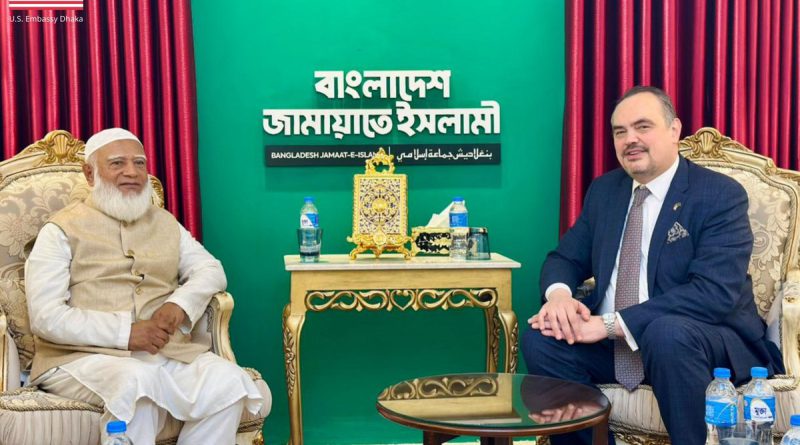
The secret dealing refereed here is the recent Washington Post report that exposed that US diplomats, behind close doors, have signalled their openness to work with resurgent Jamaat-e-Islami and to ‘want to be their friends’, on the prediction that Bangladesh has ‘shifted Islamic’ and that Jamaat ‘would do better than it has ever done before.
The report also stated that Jamaat, since Hasina’s ousting, has held four meeting with US officials in Washington and several in Dhaka, signalling a possible understanding. While Washington claims this conversation to be ‘off-the record discussion’ and ‘routine gathering’, Jamaat’s Barguna2 candidate’s confirmation of ‘even America moving forward by relying on Jamaat’, and also European Union, IMF and the Work Bank’s interest for Jamaat-led government in Bangladesh eliminates any suspicion of America’s influence on Jamaat in the 2026 polls.
The February national election is witnessing Islamist political parties fielding record number of candidates (36.35 per cent of total candidates) in the upcoming polls. Besides 224 candidates contesting from Jamaat, 253 candidates are contesting from Islami Andolan Bangladesh, 34 from Bangladesh Khelafat Majlis and 32 from National Citizen Party-NCP. The 11-party alliance now remains intact with Bangladesh Labour Party joining the Jamaat-led alliance.
The expansion of alliance to include non-Islamist parties is to paint before the world of a democratic political alliance that seeks to make Bangladesh prosperous. It, however, hides its overtly Islamist goals from them, which has only been made evident to Bangladesh’s local audience.
Disclaimer: Views expressed by writers in this section are their own and do not reflect Milli Chronicle’s point-of-view.