
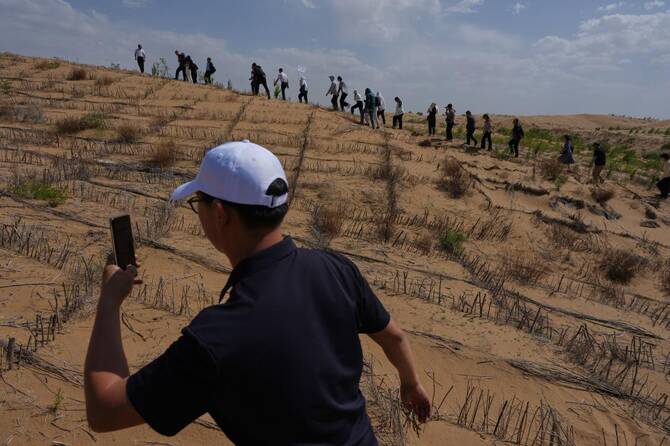
China’s Green Great Wall Slows Desertification, but Challenges Persist
KUBUQI DESERT-China’s decades-long campaign to halt the spread of desertification has significantly reduced degraded land across the country’s north, according to officials and scientists, but experts say the gains will depend on sustained investment, ecological management and local community support for years to come.
Since the launch of the Three-North Protective Forest Program in 1978, commonly known as the “Green Great Wall,” millions of workers have planted trees and stabilized sand dunes using a technique known as straw checkerboards. The method involves arranging straw in grid patterns across shifting sand before planting saplings within each square, helping reduce wind erosion and improve conditions for vegetation to grow.
The project was introduced to combat decades of land degradation caused by drought, overgrazing and unsustainable farming, which stripped vegetation, weakened soils and accelerated the spread of deserts across northern China.
According to Chinese government data, the area affected by desertification reached its peak around 2000 and has since been shrinking by more than 1,000 square kilometers annually. Authorities say forests established under the program now cover a cumulative 500,000 square kilometers, transforming vast areas once threatened by advancing deserts.
Scientists say the progress reflects decades of sustained government commitment alongside the work of millions of rural residents. Zhu Jiaojun, a researcher at the Institute of Applied Ecology under the Chinese Academy of Sciences, said long-term monitoring indicates China’s desertified land has declined by about 10 percent since 2000, while areas classified as severely or extremely desertified have fallen by more than 40 percent.
Zhu said forest cover across the program area increased from roughly 5 percent in 1978 to 14 percent by 2022. He attributed the progress to extensive restoration efforts as well as increased rainfall in some regions, describing the achievements as the result of both sustained human effort and favorable climatic conditions.
The scale of the program has relied heavily on local participation. Zhu estimated that more than 300 million rural laborers have contributed to the initiative over the decades, largely through paid, part-time work involving tree planting, maintaining vegetation and repairing straw checkerboards.
Among them is Yin Yuzhen, a desert control worker who has spent four decades restoring degraded land near the Mu Us Desert in Inner Mongolia. Speaking during a government-organized media visit to the Kubuqi Desert, she recalled working in landscapes where blowing sand severely limited visibility and wildlife was scarce.
Today, she said, the landscape has changed dramatically, with visible vegetation, improved roads and clearer skies replacing the barren conditions she experienced when she began her work. She continues maintaining trees and sand barriers alongside her family and local volunteers.
While acknowledging China’s progress, international experts caution that ecological restoration remains a long-term undertaking. Barron Joseph Orr, chief scientist at the United Nations Convention to Combat Desertification, said the program demonstrates that reversing desertification is achievable when restoration forms part of sustained national development policy.
Orr noted that restored dryland ecosystems can gradually become self-sustaining but still require long-term monitoring and careful management, with success depending on factors including water availability and soil health.
Environmental organizations have also emphasized the importance of linking restoration projects to local economic opportunities. Zhao Zhong, founder of the environmental group Green Camel Bell in Gansu province, said communities are more likely to support conservation when ecological protection also contributes to livelihoods.
Scientists say one of the project’s greatest future challenges will be determining whether restored ecosystems can remain healthy if government investment and direct human intervention are gradually reduced. Maintaining those gains, they say, will require balancing environmental protection with sustainable economic development for the communities that live alongside China’s expanding green belt.