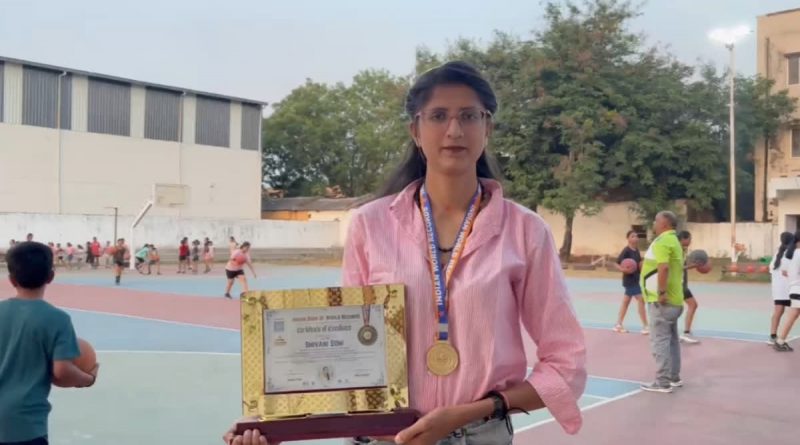
From Adversity to Achievement: Chhattisgarh’s Shivani Soni Earns National Recognition in Emerging Sports
“Supported by her Anganwadi worker mother, Shivani Soni overcame hardships to represent India globally.”
A young athlete from Chhattisgarh has emerged as a notable figure in lesser-known sports disciplines, highlighting both individual resilience and the growing diversification of India’s sporting landscape.
Shivani Soni, who was raised by her mother after being abandoned by her father, has achieved recognition in speed ball and mini golf, representing India at international platforms and securing a place in the India Book of World Records.According to reporting by ETV Bharat, Shivani’s early life was marked by economic and social challenges. Her mother, an Anganwadi worker, provided consistent support despite limited resources.
Anganwadi workers, who operate under India’s Integrated Child Development Services programme, are typically responsible for delivering basic health, nutrition, and early education services at the community level. In Shivani’s case, this role also involved sustaining her daughter’s ambitions in competitive sports.
Shivani’s achievements are particularly significant given the niche status of the sports she competes in. Speed ball, a racquet sport involving rapid striking of a tethered ball, requires high levels of coordination and reflexes, while mini golf demands precision and consistency. Both disciplines remain outside mainstream sporting circuits in India, receiving limited institutional attention compared to cricket, athletics, or badminton.
Despite these constraints, Shivani has progressed to represent India in international competitions, demonstrating the potential for athletes from non-traditional backgrounds to succeed in emerging sports. Her inclusion in the India Book of World Records further underscores the recognition of her accomplishments at a national level.
Her journey reflects broader structural issues within Indian sports development, particularly the uneven distribution of resources and opportunities. Athletes from smaller towns and economically weaker backgrounds often rely heavily on family support and local networks to pursue competitive careers.
In this context, Shivani’s progress highlights the role of grassroots encouragement in enabling talent to emerge outside established training ecosystems.Observers note that stories such as Shivani’s are increasingly visible as India expands its participation in diverse sporting disciplines. Government initiatives and private sponsorships have begun to address some gaps, though access remains uneven across regions and sports categories.
Athletes competing in less-publicised sports often face challenges related to funding, infrastructure, and exposure.Shivani’s achievements also point to the evolving definition of sporting success in India, where recognition is no longer confined to traditional or commercially dominant disciplines.
As more athletes enter global competitions across varied sports, their performances contribute to a broader redefinition of national representation.Her case illustrates how individual determination, combined with familial support, can overcome structural limitations.
While systemic challenges persist, the visibility of such achievements may encourage greater institutional attention toward emerging sports and athletes from underrepresented backgrounds.