
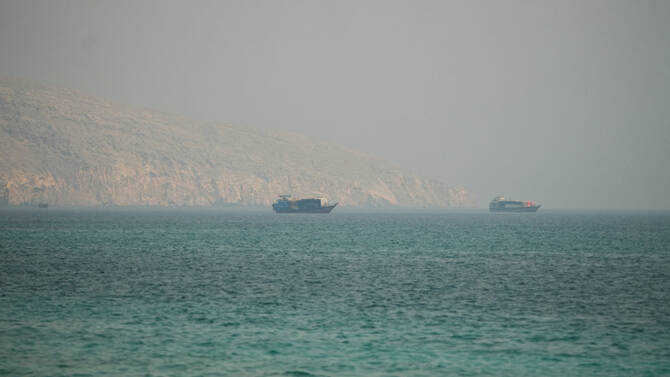
Iran Shuts Hormuz Strait, Escalating Standoff With United States
DUBAI/WASHINGTON- Iran said on Sunday it had closed the Strait of Hormuz after striking a vessel it said was using an unauthorized route through the strategic waterway, warning that any retaliation would trigger a “severe response” and further deepen tensions with the United States.
The Navy of Iran’s Islamic Revolutionary Guard Corps (IRGC) said a vessel that had endangered maritime security by switching off its tracking systems was struck and brought to a halt. The statement did not identify the ship but said several vessels had ignored warnings and attempted to transit the strait using what it described as an unauthorized route.
The IRGC said the Strait of Hormuz would remain closed until further notice and until what it called “the end of U.S. interference in this region.” It also warned that any further military action against Iran would be met with a severe response and that additional enemy bases in the region could become targets.
The announcement came as Washington pressed Tehran to publicly commit to ending attacks on commercial shipping and to guarantee unrestricted navigation through the waterway without imposing tolls, according to senior U.S. officials.
U.S. President Donald Trump said on Friday that the United States and Iran had agreed to continue talks despite an escalation in hostilities, while also declaring that an interim ceasefire was over.
A senior Iranian source told Reuters that Iran, the United States, Qatar and Pakistan had agreed to pursue negotiations through mediation efforts that were expected to coincide with Iranian Foreign Minister Abbas Araqchi’s visit to Oman. It was not immediately clear whether those discussions had produced any breakthrough.
Araqchi met Omani Foreign Minister Sayyid Badr Albusaidi to discuss what the Iranian Foreign Ministry described as appropriate mechanisms for ensuring the safe passage of ships through the Strait of Hormuz. Oman’s state news agency later said negotiations would continue at both the technical and political levels.
Oman has been mediating efforts to end the conflict that has destabilized the Gulf since U.S. and Israeli airstrikes on Iran began on Feb. 28.
Before the conflict, roughly one-fifth of the world’s traded oil passed through the Strait of Hormuz, making it one of the most strategically important maritime chokepoints. Iran’s effective blockade of the waterway has driven energy prices higher and increased concerns over global inflation.
CNN reported on Saturday that Oman had drafted a proposal under which ships could freely navigate through the southern shipping corridor in Omani territorial waters, while vessels using the northern corridor through Iranian territorial waters would require prior Iranian approval without being charged transit fees. The White House and U.S. State Department did not immediately comment on the report.
The latest tensions followed attacks earlier in the week on commercial tankers from Qatar and Saudi Arabia, incidents that prompted U.S. strikes on Iranian targets and subsequent Iranian attacks on U.S. military facilities in Gulf states.
Araqchi accused Washington of violating the ceasefire arrangement after the United States revoked waivers allowing Iran to sell crude oil in U.S. dollars following the tanker attacks. In a social media post, he said compliance with any agreement must be mutual.
Although Iran has not claimed responsibility for attacks on commercial shipping, analysts have long said Tehran has used such actions to strengthen its negotiating position during periods of heightened regional tension.
The confrontation has further undermined confidence in the interim agreement intended to halt the conflict and has pushed oil prices higher, adding pressure on global energy markets.
In a statement released on Saturday, Iran’s new Supreme Leader Ayatollah Mojtaba Khamenei vowed to avenge the death of his father and predecessor, Ayatollah Ali Khamenei, who was killed on Feb. 28. The statement said Iran remained committed to avenging those killed regardless of future developments.
Trump said on Friday he had instructed the U.S. military to be prepared to launch a massive response if Iran attempted to assassinate him, following U.S. media reports that Israel had shared intelligence with Washington regarding an alleged Iranian plot.


