
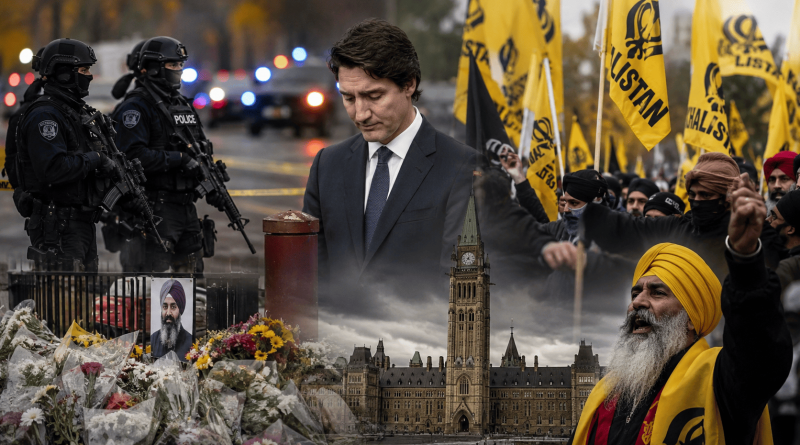
The Nijjar File: Canada’s Khalistani Vote-Bank Strategy

Operation Hard Ball has now placed organized crime, extortion networks and cross-border gang activity at the centre of the Nijjar case.
In 2018, Justin Trudeau’s India trip exposed a weakness Canadian politics still refuses to confront: Ottawa’s softness toward Khalistani extremism and its willingness to bend statecraft around Khalistani vote-bank calculations.
During that trip, Jaspal Atwal, convicted terrorist in the attempted murder of a Punjab minister and linked to the later-banned International Sikh Youth Federation, appeared at an official event. Liberal MP Randeep Sarai took responsibility for the invitation. Then National Security Adviser Daniel Jean tried to contain the fallout by briefing journalists on a theory that unnamed Indian ‘rogue elements’ may have engineered the embarrassment to sabotage Trudeau’s visit.
The theory collapsed quickly. It contradicted the government’s own claim that Sarai was responsible, made Canada look unserious, and showed how easily Ottawa reached for an India-blame narrative before confronting its own indulgence of Khalistani networks. Jean later left the role.
Canada should have learned. It did not.
After Hardeep Singh Nijjar was killed in Surrey in 2023, the same instinct returned at a far higher cost. Operation Hard Ball has now placed organized crime, extortion networks and cross-border gang activity at the centre of the Nijjar case. The Hogue Inquiry’s 2025 final report says Canada’s initial security and intelligence assessment was that the killing was likely gang or criminal related, and that the Prime Minister was informed of this.
Officials later heard from South Asian MPs and community members who insisted the killing was connected to India. That pressure has not disappeared. Even now, the push remains to preserve the India-blame narrative despite a far more complicated public record.
A murder investigation should have moved through police work, evidence and courts. Instead, after Trudeau’s September 2023 statement in the House of Commons, the Nijjar file was pulled into Parliament and shaped by Khalistani-aligned voices and MPs responsive to that constituency. The scandal is not that Canada investigated a killing on its soil. It should have. The scandal is that agencies, Parliament and public messaging were pulled into a narrative useful to a narrow political base before Canadians saw a tested case.
Liberal MP Sukh Dhaliwal presented petition e-4501, which described Nijjar as ‘law abiding’, and later sponsored Motion M-112. The motion explicitly referred to ‘credible allegations of a link between agents of the Government of India’ and Nijjar’s killing. This was no longer only a police file. Parliament had given the India-blame narrative moral authority before the public had evidence.
The community paid the bill. Across Brampton, Surrey, Mississauga, Vancouver, Calgary, and Kananaskis, protests grew louder, mandirs became flashpoints, parades grew tense, and Diwali itself was pulled into the fallout when Leader of the Official Opposition Pierre Poilievre cancelled a planned Diwali on the Hill event in 2024. For ordinary families, this was not foreign policy. It was local life. Hindu Canadians felt targeted by anti-India anger that spilled into anti-Hindu hostility.
Canada’s naïve political class still seems not to understand that Hindus in Canada do not come only from India; many are from the Caribbean, Fiji, Sri Lanka, Nepal and elsewhere. Sikhs who rejected Khalistani extremism were punished too, branded traitors, sellouts or agents of India. Indo-Canadians with no role in this politics were forced into camps they never chose.
That is why the Hindu-versus-Sikh framing is so dangerous, and so useful to Khalistani politics. It recasts extremism, intimidation, criminality and terrorism as a religious dispute. It allows Khalistani actors to hide behind community grievance while targeting anyone who challenges them: Hindus, Sikhs, Jews, Christians, Muslims, journalists, politicians, families and critics within their own community.
Social media accelerated the damage. Clips and slogans replaced facts. The case was flattened into India versus Canada, Hindu versus Sikh, loyalty versus betrayal. Hate travels faster when politicians give it vocabulary.
Operation Hard Ball complicates that script. Public reporting has identified Lawrence Bishnoi by the name Balkaran Brar, making it harder to sustain the simplistic claim that this is merely a Hindu-nationalist story. The alleged network around him is not a religious movement; it is a criminal ecosystem. Yet the communal framing persists because it is politically useful.
Nijjar’s history was never as simple as Canadian politics made it sound. He was linked the banned terrorist organization Khalistan Tiger Force, and public reporting had raised questions about his security profile. None of that justified his killing. But it should have prevented Ottawa from letting him be converted into a martyr-symbol for domestic politics.
Canada had already failed this test after Air India Flight 182, when victims’ families were sidelined, Sikh critics of extremism were threatened, and Talwinder Singh Parmar, identified as the mastermind of Canada’s deadliest terrorist attack, was later glorified by extremists here. Instead of learning that radicals fill every vacuum Canada leaves behind, Ottawa created another one around Nijjar.
Canada must now treat transnational crime as a national-security threat, protect all communities and critics of extremism equally, and keep Parliament, agencies and intelligence processes away from Khalistani and extremist vote-bank theatre.
The bottom line is simple: Ottawa allowed political pressure to shape a national narrative, empowered radical voices, polarized Indo-Canadians and weakened trust in public institutions.
That is not leadership. It is the cost of weaponizing the system for politics.
Disclaimer: Views expressed by writers in this section are their own and do not reflect Milli Chronicle’s point-of-view.


