Taiwan Presses Washington for $14 Billion Arms Package Amid Rising China Pressure
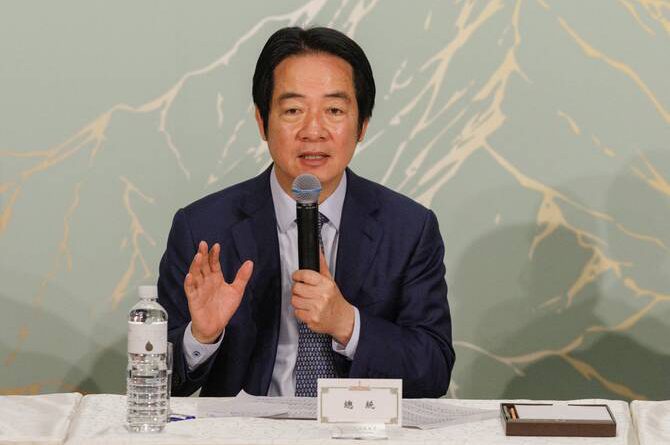
Taipei-Taiwan President Lai Ching-te on Thursday urged the United States to approve a proposed $14 billion arms package as soon as possible, saying the self-governed island must strengthen its defenses against growing military and political pressure from China.
Speaking to reporters in Taipei, Lai said Taiwan’s efforts to safeguard its security, democratic system and way of life should not be viewed as a provocation toward Beijing. He reiterated that the island rejects unification under the rule of the Chinese Communist Party and remains committed to enhancing its self-defense capabilities.
The request comes as Washington reviews the proposed arms package, which includes advanced U.S.-developed weapons systems. U.S. Secretary of State Marco Rubio said earlier this month that the proposal remained under consideration, while American officials have also assessed the impact of overseas military commitments on available weapons stockpiles.
The United States maintains unofficial relations with Taiwan and is legally obligated under domestic legislation to provide the island with defensive capabilities, despite formally recognizing Beijing as the sole government of China. Arms sales to Taiwan remain one of the most contentious issues in U.S.-China relations.
Responding to Lai’s remarks, Chinese Foreign Ministry spokesperson Lin Jian said attempts to pursue independence through U.S. support or military means were destined to fail. He accused Taiwan’s leadership of escalating regional tensions and dismissed Taipei’s defense initiatives.
China claims Taiwan as part of its territory and has repeatedly stated that it reserves the right to use force to bring the island under its control. Taiwan rejects Beijing’s sovereignty claims and maintains that its future should be determined by its people.
Lai’s administration has pledged to raise defense spending above 3 percent of gross domestic product this year. The government has proposed a broader defense procurement plan worth approximately NT$1.25 trillion ($40 billion), including purchases of American weaponry, domestically produced drones and other military equipment.
However, the proposal has faced resistance in Taiwan’s legislature. Opposition parties, which hold a majority of seats, approved a reduced special defense budget last month worth about $25 billion, cutting roughly one-third of the funding requested by the government.
In a move aimed at addressing capability gaps, Taiwan’s cabinet on Thursday approved an additional NT$210 billion ($6.6 billion) for indigenous unmanned systems. The defense ministry has argued that the reduced budget approved by lawmakers would be insufficient to fully achieve planned force modernization goals.
Lai also accused China of increasing pressure on neighboring countries, including Japan and the Philippines, amid maritime disputes in waters east of Taiwan. His comments followed recent announcements by Tokyo and Manila that they would begin formal negotiations to delimit maritime boundaries between their exclusive economic zones and continental shelves.
China has opposed those talks and continues to assert broad claims across the East and South China Seas. Lai said Beijing’s military activities and coercive actions in the Taiwan Strait and wider Indo-Pacific region were expanding, raising concerns among regional governments.
Japan and the Philippines have strengthened security cooperation in recent years amid shared concerns over China’s maritime claims and growing military presence across disputed waters.