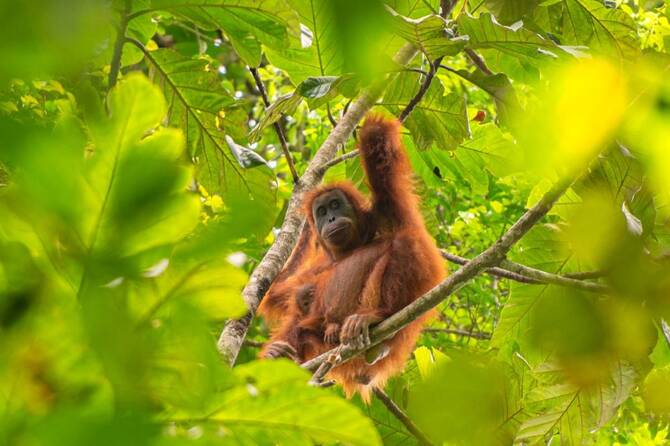
Climate-Fueled Disaster Pushes World’s Rarest Orangutan Toward Extinction
Jakarta- Climate change-driven landslides in Indonesia’s North Sumatra killed an estimated 58 Tapanuli orangutans last year, eliminating roughly 7% of the species’ remaining population and intensifying concerns over the survival of the world’s rarest great ape, according to a new scientific study.
The findings, published on Wednesday in the journal Current Biology, link the losses to devastating floods and landslides triggered by Cyclone Senyar, which struck northern Sumatra in November and caused widespread destruction across the region.
The storm killed more than 1,200 people and damaged over 180,000 homes in three provinces. Environmental organizations previously attributed the scale of the disaster partly to extensive deforestation in affected areas.
Researchers found that approximately 58 Tapanuli orangutans were killed in landslides across the Batang Toru ecosystem, the only known habitat of the critically endangered species. Fewer than 800 individuals are believed to remain in the wild.
Using satellite imagery, scientists identified about 8,300 hectares affected by landslides in the Batang Toru region following the extreme rainfall event. The study concluded that orangutans likely died from falling trees, burial under landslides and drowning during prolonged flooding.
The authors said the estimate was conservative because the analysis covered only landslides in western Batang Toru and excluded indirect impacts such as food shortages and canopy destruction that may also have increased mortality.
“Our findings provide quantitative evidence that extreme rainfall events can directly threaten great ape survival,” the researchers wrote.
They warned that the deaths represent a significant demographic setback for a species characterized by slow reproduction rates and high sensitivity to population losses.
Previous scientific assessments have suggested that the Tapanuli orangutan, identified as a distinct species in 2017, could face extinction if annual population declines exceed 1%.
The study adds to growing evidence linking biodiversity threats to climate change. Researchers previously found that human-induced climate change increased Cyclone Senyar’s rainfall intensity by between 10% and 50%, amplifying the likelihood and severity of landslides.
Friederike Otto, a climate scientist at Imperial College London and co-author of the study, said the findings illustrate how climate change and biodiversity loss are becoming increasingly interconnected.
She said human-driven warming transformed a severe tropical storm into a catastrophic trigger for landslides that devastated both human communities and wildlife populations.
The researchers urged immediate conservation measures to protect the Batang Toru ecosystem, warning that continued habitat degradation combined with climate-related disasters could accelerate the species’ decline.
Jatna Supriatna, a biology professor at Universitas Indonesia and co-author of the study, called for permanent protection of the Batang Toru forest and greater international financial support for biodiversity recovery efforts.
He said stronger conservation action is essential to prevent what could become the first modern extinction of a great ape species.