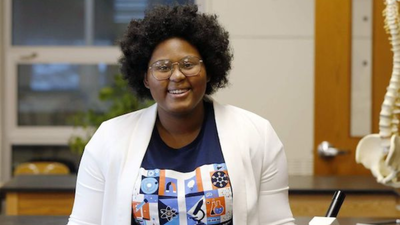
Teen Researcher Dasia Taylor Develops Low-Cost Surgical Sutures That Detect Infection Through Colour Change
“Her goal was to create something more affordable and equitable, especially for lower-income communities.”
At age 17, American student researcher Dasia Taylor developed a low-cost surgical suture designed to change colour when infection develops in a wound, an invention that drew national attention for combining medical innovation with healthcare accessibility.
Taylor began the project in 2019 while studying at Iowa City West High School in Iowa. The idea emerged after a classroom discussion about science fairs and medical technologies, leading her to investigate advanced “smart” sutures already under development in the healthcare industry.
Existing smart sutures can detect infection-related changes by measuring electrical resistance and transmitting alerts through connected digital systems. However, Taylor concluded that such technologies were often expensive and difficult to deploy in low-resource healthcare settings lacking reliable internet access, smartphones or advanced medical infrastructure.
Instead, she focused on creating a simpler and less costly alternative that could visually indicate infection without requiring electronic equipment.Taylor’s breakthrough came after researching pH changes associated with infected wounds. She found that infected tissue typically becomes more alkaline and discovered that beet juice naturally changes colour at roughly the same pH range.
Using beet-derived dye applied to cotton-polyester surgical thread, Taylor developed sutures that shifted from bright red to dark purple under infection-like laboratory conditions.According to her tests, the colour transition occurred within approximately five minutes after exposure to pH levels associated with wound infection.
In the design, the beet extract functioned as the chemical sensor reacting to pH changes, while the cotton-polyester thread acted as the physical carrier for the dye compound.Taylor said the project evolved gradually through experimentation rather than beginning as a fully developed invention.
The work attracted attention because it addressed both scientific and public health concerns simultaneously. Taylor repeatedly framed the project around accessibility and affordability, particularly for communities where infections may go undetected because of limited healthcare resources.Her focus on equity later shaped the name of her venture, Variegate, which she said referenced both colour variation and social diversity.
Born in Chicago in 2004 and later raised in Iowa, Taylor has spoken publicly about growing up in a single-parent household and said those experiences influenced her interest in healthcare accessibility and social inequality.Alongside her scientific research, she became involved in educational and racial equity advocacy during her school years, participating in school board discussions and supporting conversations around anti-racist educational initiatives.
Taylor’s research project gained recognition through state and regional science competitions before reaching national prominence in 2021, when she was named one of 40 finalists in the Regeneron Science Talent Search, one of the most prominent science competitions for high school students in the United States.She also received the Seaborg Award as part of the competition.
Her work has since been featured by national media outlets and science education organisations, including appearances on PBS NewsHour and The Ellen DeGeneres Show.Taylor is currently studying at the University of Iowa while continuing efforts to patent the infection-detecting sutures and expand her healthcare-focused research initiatives.Medical researchers have increasingly explored “smart” wound-care materials capable of identifying infection earlier than traditional visual diagnosis.
Infections often alter wound chemistry before severe physical symptoms become visible, making early detection an important focus in surgical recovery and public health research.
Taylor’s work drew attention partly because it proposed a simpler, visually observable approach using widely available materials rather than relying on expensive digital monitoring systems.
The project has been widely cited by educators and STEM advocacy groups as an example of student-led innovation aimed at solving practical healthcare problems with low-cost solutions.