Bangkok’s Street Food Faces Squeeze as Vendor Crackdown Reshapes City Life
Bangkok- Bangkok’s iconic street food culture is facing mounting pressure as city authorities tighten restrictions on roadside vendors, pushing thousands to relocate to designated hawker centers in an effort to clear sidewalks and regulate public spaces, a policy that many sellers say threatens both livelihoods and the capital’s culinary identity.
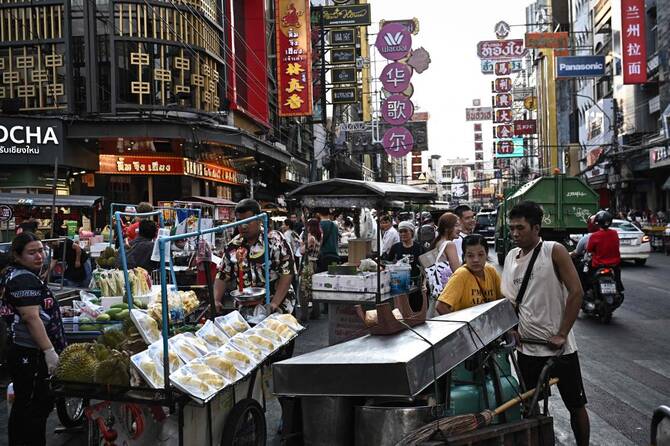
Known for its bustling curbside kitchens, smoky grills and roadside noodle carts, Bangkok’s street food scene has long been a defining feature of the Thai capital, attracting both residents and tourists seeking quick, affordable meals across neighborhoods from Chinatown to Lumphini Park.
But the Bangkok Metropolitan Administration (BMA) has accelerated efforts in recent years to remove vendors from busy pavements, arguing that overcrowded footpaths and obstruction in commercial districts require stronger enforcement and better urban management.
Since 2022, the estimated number of mobile street vendors in Bangkok has dropped by more than 60%, with around 10,000 fewer operating on city streets, according to BMA data.
Many vendors have shifted to informal markets or one of five hawker centers established by the city using a model similar to Singapore’s centralized food courts, while others have shut down entirely because stricter regulations made operations unsustainable, said BMA official Kunanop Lertpraiwan.“We give them time and communicate with them clearly,” Kunanop said, adding that vendors are often given months to find new locations before enforcement begins.
“It’s not like we will move them tomorrow,” he said.The latest hawker center opened in April near Lumphini Park, one of Bangkok’s busiest public spaces, where vendors now pay 60 baht ($1.80) per day for a stall equipped with electricity, water access and covered seating areas.
For some, the transition has improved working conditions.Panissara Piyasomroj, 59, who sold noodles to morning runners near the park since 2004, said relocating to the formal center made her business cleaner and easier to manage.“Under a roof, with water and electricity, it feels upgraded,” she said.
Yet for many long-time sellers, relocation remains financially and emotionally difficult, particularly for older vendors who rely on regular customers and foot traffic built over decades.In Bangkok’s Chinatown, Looknam Sinwirakit continues selling fried glutinous rice cakes for 50 baht despite previously being fined 1,000 baht ($30) for blocking the sidewalk.
“I am worried because we are here illegally,” said the 45-year-old vendor. “Vendors need to earn a living. It’s not fair just to evict us.”Nearby, durian seller Wong Jaidee, 56, who has worked the same streets for more than 20 years, said he had no clear alternative if authorities forced him to leave.
“I don’t have any backup plan,” he said. “Bangkok is a high-priced city and we may not be able to cope.”For elderly vendors such as Thitisakulthip Sang-uamsap, 67, who has sold fried vegetable balls near Chinatown for over four decades, the uncertainty is especially acute.“I live around here,” she said. “If they ask me to leave, I won’t be comfortable.”
Officials say enforcement has mainly focused on major roads with heavy pedestrian congestion, while side streets and tourist-heavy districts have been given more flexibility.Still, the policy has raised broader concerns about preserving one of Bangkok’s strongest cultural and tourism assets.
Visitors often see roadside stalls not simply as food outlets but as part of the city’s identity, where the smell of grilled squid, garlic and chili shapes the urban experience as much as its temples and markets.
German tourist Oliver Peter, eating Pad Thai from a roadside stall, said the disappearance of such vendors would change the city’s character.“It would be sad if they go away,” he said. “It’s part of the culture.”