Bali Waste Crisis Deepens as Landfill Closure Leaves Trash Piling Up
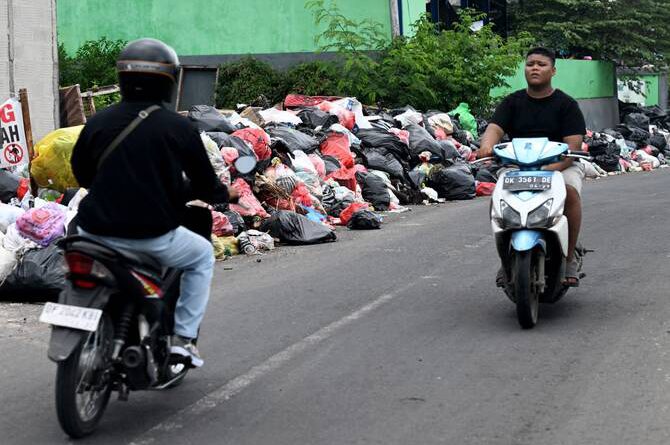
Denpasar – Piles of uncollected garbage are building up across Indonesia’s resort island of Bali after authorities restricted access to its largest landfill, exposing gaps in the government’s effort to enforce a long-standing ban on open dumping and raising concerns over public health, tourism and environmental damage.
Since the beginning of April, Bali’s main landfill at Suwung has been closed to most organic waste as part of Jakarta’s push to phase out open landfills nationwide, a policy formally introduced in 2013 but only now being enforced more aggressively.
With limited replacement infrastructure in place, residents and businesses say waste is accumulating on roadsides, attracting rats and prompting some people to burn rubbish in the open, sending smoke through densely populated neighborhoods.“As a business owner, this is a real nuisance,” said Yuvita Anggi Prinanda, who runs a flower stall in Denpasar and generates several large bags of plant waste each day.
She said she had paid a private company to remove garbage near her shop after the smell began driving away customers.Bali produces an estimated 3,400 tons of waste daily, a figure driven in part by tourism on an island that welcomed around seven million visitors last year, far exceeding its local population of about 4.4 million.
At Kuta beach, one of Bali’s busiest tourist areas and a location frequently affected by marine plastic debris, rubbish bags have been stacked high in parking areas as collection systems struggle to cope.“You have many rats here at nighttime.
The smell is not very good it’s not a good look,” said Australian tourist Justin Butcher.Authorities have warned that people caught illegally dumping or burning trash face up to three months in jail and fines of 50 million rupiah ($3,000), according to Bali public order agency head I Dewa Nyoman Rai Dharmadi.But sanitation workers say the restrictions have left them with few practical options.
“If we don’t collect our client’s trash, we are in the wrong, if we collect it, where do we dispose it?” said I Wayan Tedi Brahmanca, one of hundreds of workers who drove garbage trucks to the governor’s office in protest on April 16.
Following the demonstration, the provincial government said limited disposal at Suwung would be temporarily allowed until the end of July.From August, however, Indonesia plans to fully end the use of open landfills nationwide, despite uncertainty over replacement systems.
Waste management expert Nur Azizah of Gadjah Mada University said Suwung receives about 1,000 tons of waste per day and has been operating beyond capacity for years.She said up to 70% of the waste was organic material, which can produce methane gas over time, creating fire and landslide risks.
Such incidents have occurred repeatedly in Indonesia, including a collapse in March at the country’s largest landfill outside Jakarta that buried trucks and food stalls and killed seven people.Indonesia’s environment ministry says the country’s 284 million people generate more than 40 million tons of waste annually, with nearly 40% made up of food waste and almost one-fifth plastic.
Only about one-third of that waste is formally managed through recycling or processing, according to researchers, while the rest is often dumped into rivers, landfills or open land.
Fewer than one-third of Indonesia’s 485 landfills have shut since the open-dumping ban was introduced more than a decade ago.“We have not been managing waste properly, resulting in an emergency in all cities and regencies,” former environment minister Hanif Faisol Nurofiq said recently.
The government plans to begin construction in June on several waste-to-energy projects, including one in Bali expected to process around 1,200 tons of waste per day, though officials say such facilities may take years to become operational.