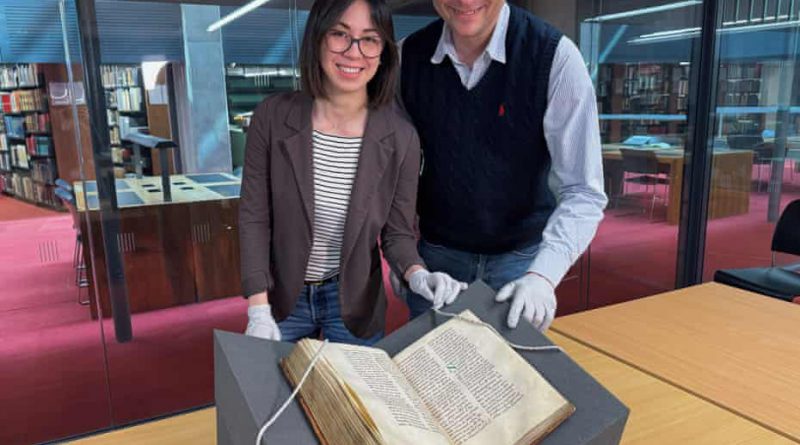
Lost in Time, Found in Rome: Scholars Unearth Earliest English Poem Manuscript After 1,200 Years
“When we saw it, we looked at each other and I said, ‘No one knows about this.”
A remarkable literary discovery in Rome has brought one of the oldest surviving works in the English language back into scholarly focus, as researchers from Trinity College Dublin uncovered a previously unknown manuscript of Caedmon’s Hymn, a seventh-century Old English poem believed to be the earliest surviving English poem.
The manuscript, hidden for centuries within the holdings of the National Central Library of Rome, contains a version of the famous nine-line hymn composed by Caedmon, an illiterate cattle herder from Northumbria whose story was first recorded by the medieval monk and historian Bede in the eighth century.
The discovery is being hailed by medieval scholars as one of the most significant literary finds in recent years, not only because of the poem’s age but because of the unique form in which it survives. Unlike older known copies, where the Old English text appeared only as marginal notes beside Latin text, the Rome manuscript places the Old English version in the main body of the manuscript itself evidence of the growing prestige of English as a written language during the early medieval period.
Researchers Elisabetta Magnanti and Mark Faulkner made the discovery while investigating conflicting records about manuscripts linked to Bede’s Ecclesiastical History of the English People, one of the foundational texts of early English history.Magnanti, a specialist in medieval manuscripts, requested the Roman library to check its archives for overlooked documents.
Library staff located the manuscript, digitised it, and sent the images to Dublin. When the scholars examined the pages, they immediately realised they had found something extraordinary.“When we saw it, we looked at each other and I said, ‘No one knows about this,’” Magnanti recalled. “To make sure I wasn’t dreaming, I double-checked the catalogues and there was no mention of it.
It was a huge surprise.”Experts believe the manuscript was copied by a monk in northern Italy sometime between AD 800 and AD 830, making it around 1,200 years old. It is now considered the third-oldest surviving version of the poem, following even earlier copies preserved in Cambridge and St Petersburg.The significance of the Rome version lies not only in its age but in what it reveals about language and literary culture.
According to Faulkner, the decision to place the Old English text within the central manuscript rather than on the margins suggests that English poetry had achieved a new level of importance among early readers.“The absence of the poem would have been felt by the readers,” Faulkner explained. “That is why it goes in.”The manuscript also offers fascinating clues about the evolution of written English.
Every word in the poem is separated by a full stop, showing that scribes were still experimenting with systems of spacing and punctuation. In the early medieval world, texts were often written continuously without spaces between words, making reading a more demanding skill.
Faulkner noted that the punctuation reflects a transitional moment in writing practices. “It is part of the early development of ways of dividing words and shows text starting to come towards the presentation of English that we know today,” he said.Caedmon himself remains a legendary figure in English literary history.
According to Bede, he worked as a cattle herder at Whitby Abbey and was unable to read or write. One night, after reportedly receiving a divine vision, he was inspired to compose and sing a hymn praising God’s creation of the world.
That poem became known as Caedmon’s Hymn, a brief but powerful expression of Christian devotion and poetic skill. Bede included a Latin translation of the work in his historical writings but omitted the original Old English version.
Later scribes, however, ensured that the original language survived.Within a century, a monk connected to the abbey of Nonantola in northern Italy included the Old English text in a manuscript, preserving what many scholars now regard as the first known English poem.
The newly identified Rome manuscript strengthens the evidence of how widely respected the poem had become across medieval Europe. Despite being written in Old English, far from Italy’s linguistic world, the poem was carefully copied and preserved by continental monks.
“There are at least 160 surviving copies of Bede’s history,” Faulkner said, adding that the continued transmission of Caedmon’s work shows how much early readers valued English poetry.
The findings have been published in Early Medieval England and its Neighbours, an open-access academic journal issued by Cambridge University Press. Scholars believe the discovery may prompt renewed study of neglected manuscript collections across Europe, particularly as libraries continue large-scale digitisation efforts.
Andrea Cappa, head of manuscripts and rare books at the Roman library, said the institution is working to digitise holdings from Italy’s National Centre for the Study of the Manuscript, a project expected to make more than 40 million images available to researchers worldwide.
Magnanti described the discovery as proof of how digital access is transforming scholarship. Without digitisation, the manuscript may have remained unnoticed for decades longer.“This discovery is a testament to the power of libraries to facilitate new research by digitising their collections and making them freely available online,” she said.
For literary historians, the recovery of the manuscript is more than an archival triumph it is a rare glimpse into the birth of English literature itself.The modern poet Paul Muldoon translated the hymn into contemporary English in 2016, capturing its timeless reverence:“Now we must praise to the skies, the Keeper of the heavenly kingdom, The might of the Measurer, all he has in mind, The work of the Father of Glory, of all manner of marvel.”
Across thirteen centuries, Caedmon’s voice once believed lost to time has spoken again.