India’s Tiger Reserves Tighten Safari Rules as Wildlife Tourism Faces Global Pressure for Reform
“Conservation comes first—when the animal becomes secondary to the photograph, wildlife tourism stops being conservation and starts becoming intrusion.”
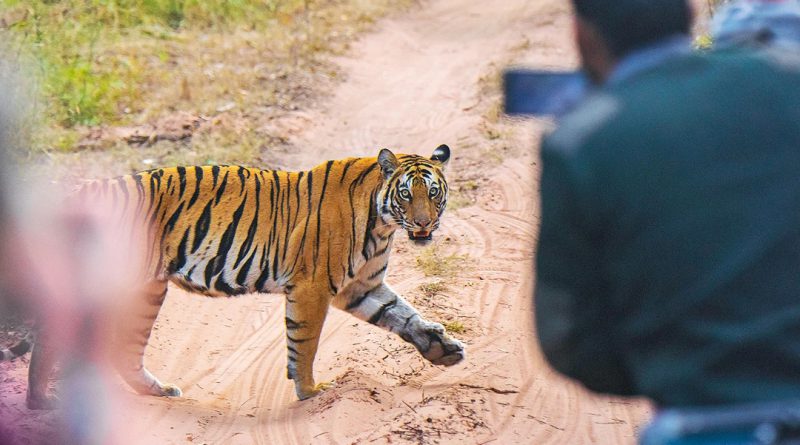
India’s tiger reserves are imposing stricter rules on safari tourism, including restrictions on mobile phone use in core wildlife zones, as authorities respond to growing concerns that uncontrolled tourism is placing both animals and visitors at risk.
The move follows a Supreme Court ruling issued in November 2025 that banned the use of mobile phones inside the core tourism zones of several tiger reserves, citing safety concerns and the disruptive behaviour increasingly associated with wildlife tourism.
Visitors are now required either to deposit their phones before entering protected areas or keep them switched off and stored away during safaris.The ruling reflects wider concern over the rise of what conservationists and safari operators describe as “safari jams,” where multiple tourist vehicles crowd around a single animal sighting, often causing visible distress to wildlife and creating dangerous situations for visitors.
A widely shared video from February 2026 brought the issue into national focus. Filmed inside Ranthambore National Park, the footage showed a wild tiger surrounded by several safari vehicles while tourists photographed and shouted from close range. The animal appeared trapped as it attempted to move back into the forest.
Tourism professionals say such scenes have become increasingly common as visitors seek not only to observe wildlife but also to document themselves alongside it, often through selfies and geotagged social media posts.India is home to more than 3,600 wild Bengal tigers, accounting for roughly 75% of the global wild tiger population.
Most live across the country’s 58 officially designated tiger reserves, including Jim Corbett National Park and Ranthambore. Conservation efforts have contributed to a significant rise in tiger numbers, with populations doubling between 2010 and 2022, according to official wildlife estimates.At the same time, tiger tourism has expanded rapidly, increasing pressure on reserve infrastructure and wildlife habitats.
Authorities recorded 418 accidental tiger-related deaths in India over the past five years, underscoring the risks associated with close human-animal encounters.Charukesi Ramadurai, an Indian journalist who has reported extensively on wildlife tourism, said the pursuit of photographs has changed safari behaviour in ways that create avoidable danger.
“People have got reckless in getting photos with the animals, and there have been incidents of the phone falling off and guides having to jump off the jeep to retrieve the phone,” she said. She also recalled an incident where a child reportedly fell from a safari vehicle while a parent was attempting to take a selfie near a tiger sighting, forcing a guide to intervene.
Sharad Kumar Vats, chief executive of Nature Safari India, said mobile phones have affected safaris beyond individual behaviour inside vehicles.Messaging applications allow drivers and guides to quickly circulate tiger sightings, which can result in a sudden concentration of vehicles in a single location. Geotagged photographs shared online also create long-term problems by revealing sensitive wildlife locations.
“If people tag their photos, specific spots become known as the watering hole of the tiger with the cubs, and everyone goes there,” Vats said. “But you have to keep that area as inviolate as possible.”He said maintaining distance is critical to reducing stress on animals and preserving natural behaviour. “If we are not sensitive to them, they will cease to be.
And when there is no tiger, there will be no tiger tourism,” he added.The Supreme Court’s broader order also includes a ban on night safaris in tiger reserves, restrictions on road use between dusk and dawn except for emergency vehicles, and tighter controls on development in fringe areas around protected forests.
The measures aim to reduce habitat disturbance while supporting more sustainable tourism models.Rather than encouraging mass tourism, the ruling gives priority to homestays and community-managed establishments, reflecting a policy shift toward lower-impact tourism that distributes economic benefits locally.
Operators were given between three and six months to implement the measures, with the full impact expected to become clearer later in 2026 when reserves reopen after the monsoon season.Ritu Makhija, a Mumbai-based sustainable tourism consultant, said the changes require a wider reset in how the tourism industry approaches wildlife travel.
“The principle is simple and necessary: conservation comes first,” she said. She argued that operators should move beyond a singular focus on tiger sightings and instead design slower, better-managed daytime experiences that respect ecological limits.
She said lodges should invest in low-impact infrastructure and align with environmental standards, while travel planners should prepare visitors for more immersive wildlife experiences rather than guaranteeing dramatic close encounters.India’s regulatory shift mirrors broader international efforts to tighten wildlife tourism rules.
In Kenya, the Ministry of Tourism and Wildlife introduced stricter behavioural standards for tour operators after footage from the annual wildebeest migration showed safari vehicles blocking the path of migrating animals.
Operators were warned that violations could result in disciplinary or legal consequences.In Svalbard, new polar bear viewing regulations introduced last year require wildlife cruises to remain between 300 and 500 metres away from the animals depending on the season, reflecting growing concern over tourist disturbance in fragile Arctic ecosystems.
In Sri Lanka, overcrowding in national parks has prompted local tourism operators to call for stronger government intervention and clearer visitor controls as wildlife tourism continues to grow.Zarek Cockar, a private safari guide in Kenya, said the issue extends beyond mobile phones and into the expectations visitors bring with them.
He argued that professional photographers using large equipment and demanding close access can be more disruptive than tourists quietly taking pictures on phones. The larger problem, he said, is the assumption that a successful safari depends on proximity and dramatic imagery.
“If guests arrive believing wildlife encounters are about getting ever closer or capturing a dramatic shot at any cost, the guide is then placed under enormous pressure to deliver,” he said.For conservation experts, the challenge is balancing tourism revenue with ecological protection. Wildlife tourism remains a major economic driver for communities around protected areas, but the sustainability of that model depends on ensuring the animals themselves are not treated as attractions to be pursued at any cost.
As tiger reserves across India reopen under stricter controls, the success of the new rules may depend less on enforcement alone and more on whether visitors accept that the best wildlife encounter is often the one observed from a respectful distance.