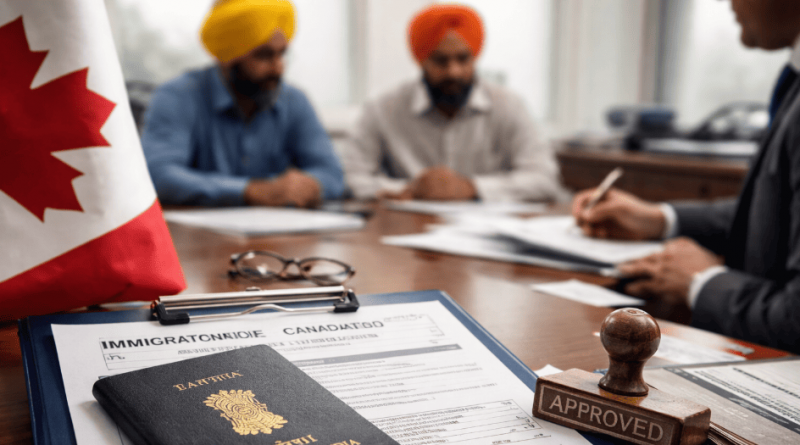
Asylum or Loophole? Why Canada Should List India as a Safe Country of Origin

In Khalistan-adjacent cases, the route is often packaged as ‘human rights’, but the toolkit is familiar: coaching, paperwork, and performance.
In July 2023, The Times of India reported on a ‘sting’ based on a Daily Mail (UK) investigation in which an undercover reporter was allegedly coached by rogue UK lawyers to claim he was a Khalistani supporter to seek asylum. In the same month, The Economic Times reported the UK legal watchdog opened an investigation and noted then-Prime Minister Rishi Sunak condemned the conduct. The point isn’t the UK’s internal politics. It’s the mechanism, when an asylum channel becomes a repeatable script, coached identity, packaged ‘proof’, intermediaries paid to shape the story, it stops being protection and starts being a loophole.
Canada should recognize the same mechanics at home. Canada has grappled with politicized claim-making tied to India since the late 1970s and early 1980s, intensifying in the mid-1980s. What has changed is scale, and how easily a modern ecosystem can industrialize claims through brokers, staged political identities, and document markets. In Khalistan-adjacent cases, the route is often packaged as ‘human rights’, but the toolkit is familiar: coaching, paperwork, and performance.
The pipeline depends on a simple mechanism: documents. A widely circulated clip shows Simranjit Singh Mann (President, Shiromani Akali Dal (Amritsar)) describing issuing ‘letters’ used for asylum or immigration pathways to raise money for his political party. This was not only social-media rumour. The Economic Times ran a video report summarizing the controversy and the alleged admission about charging money per letter, while The Print reported on Punjabi illegal migration routes and described reliance on asylum letters and the surrounding political ecosystem. When intermediaries can mass-produce ‘persecution letters’ and coached narratives, asylum becomes a marketplace and the integrity cost is paid by everyone else.
A related thread amplifying the issue is here:
The second layer of evidence is adjudication. When these claims are tested against proof, many do not survive. In Canada, The Indian Express reported that at least 30 Federal Court judicial reviews tied to Khalistan-linked claims were dismissed in 2025, with judges giving ‘minimal weight’ to last-minute social-media posts, referendum cards, and templated affidavits. Hindustan Times summarized the same pattern and noted only a small number were sent back for rehearing.
Canadian legal reporting has also highlighted Federal Court-upheld refugee denials where evidence was found insufficient to substantiate persecution claims. Earlier legal summaries tracked rejected India/Sikh-identity claims where core elements could not be established on the evidence presented. (Lawyers Weekly summary, May 2016.)
The third layer is international: other democracies are seeing similar credibility gaps. In Australia, SBS Punjabi reported a tribunal finding that an applicant had fabricated persecution claims, including claimed political links.
In the UK, a High Court decision records an asylum claim refused and certified as ‘clearly unfounded’ under section 94 of the Nationality, Immigration and Asylum Act 2002. In New Zealand, Moneycontrol reported a tribunal rejecting an Indian Sikh man’s claim, citing inconsistencies and insufficient risk. Different legal systems, same conclusion: when evidence is tested, many narratives don’t hold.
This is the context in which policy choices in peer democracies make sense. In November 2023, the UK Home Office announced India would be added to its ‘safe states’ list under the Nationality, Immigration and Asylum Act 2002, facilitating removals and making most claims harder to sustain absent exceptional circumstances. It may be inaccurate to claim one sting ‘caused’ that decision, but it did expose exactly why safe-state tools exist: to prevent a high-volume, low-credibility claim stream from overwhelming the system while preserving an exception route for genuinely individualized risk.
Canada should draw the practical lesson, because Canada’s scale is now unforgiving. The Canadian Museum of Immigration at Pier 21 notes that before the modern determination framework matured, inland refugee claims were at the level of ‘hundreds per year.’ (Canadian Museum of Immigration at Pier 21, undated background page.)
Today, the Immigration and Refugee Board’s Refugee Protection Division shows 190,039 claims referred in 2024, with 272,440 pending at year-end. (IRB–RPD statistics, 2024.) India has become one of the largest source countries: 32,563 claims referred in 2024 (about 17% of all referrals), and 17,835 in 2025 (about 16.5%). (IRB–RPD statistics, 2024.) When volumes are that high, even a small percentage of coached, brokered, document-manufactured claims can distort the entire system.
That leads to the policy conclusion Canada keeps avoiding: Canada should treat India as a safe country of origin for most asylum and human-rights claims, while preserving a narrow, individualized pathway for exceptional cases supported by strong evidence. This debate should not be taboo. The question is not whether India is perfect. No country is.
The question is whether Canada should continue treating India, one of the world’s largest democracies with elections, courts, a vibrant press, and internal legal remedies, as presumptively equivalent to states where dissent reliably ends in disappearance. India’s democracy does not require Canada to ‘certify’ it; Canada does need to certify something, and that is the integrity of its own asylum system. A safe-country designation is not a medal for India. It is a governance tool for Canada.
Canada can remain committed to refugee protection while acknowledging what these outcomes signal: the system is being exploited, and exploiters rely on Canada’s procedural fairness as cover.
Canada should also take an immediate integrity step: any claims that relied on letters attributed to Simranjit Singh Mann should be re-examined and reconsidered, with document forensics where appropriate and consequences for intermediaries who knowingly facilitated falsified evidence. If inputs are compromised, outcomes cannot be trusted and a protection system that cannot revisit compromised inputs is not protection. It is a subscription service.
This is not an attack on Indians, Sikhs, or dissent. It is recognition that asylum is not a lifestyle option, not a business model, and not a political shield. It is protection for the genuinely persecuted and Canada should start governing like it still believes that.
Disclaimer: Views expressed by writers in this section are their own and do not reflect Milli Chronicle’s point-of-view.