Mass Funeral for Khamenei Draws Calls for Revenge in Tehran
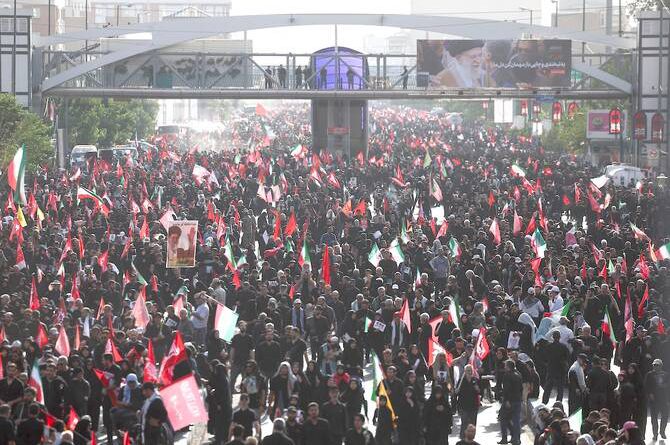
TEHRAN-Tens of thousands of mourners filled the streets of Tehran on Monday for the funeral procession of Iran’s slain Supreme Leader Ayatollah Ali Khamenei, with crowds calling for retaliation against the United States as Iranian authorities sought to project national unity following weeks of conflict with Israel and Washington.
State television broadcast aerial footage showing large crowds gathering along major avenues in central Tehran as the coffins of Khamenei and four members of his family were carried through the capital on a truck. Firefighters sprayed water over the procession to help people cope with the summer heat.
As the convoy moved through the city, some mourners threw stones at a billboard depicting U.S. President Donald Trump. The billboard accused the United States of responsibility for Khamenei’s death and carried slogans demanding retribution.
Participants also waved Iranian national flags and red banners bearing slogans calling for vengeance, reflecting a recurring theme throughout the official mourning ceremonies.
The funeral forms part of a week-long series of commemorations following the deaths of Khamenei and four relatives in Israeli airstrikes on Feb. 28, which Iranian authorities say were carried out with U.S. intelligence support.
Authorities established extensive security measures during the ceremonies, including concrete barriers separating mourners from the coffins, in an effort to prevent crowd surges similar to those that disrupted the 1989 funeral of Ayatollah Ruhollah Khomeini.
The ceremonies also serve as a demonstration of political continuity after five weeks of war with Israel and the United States. Iranian leaders have emphasized public participation as evidence of support for the country’s leadership following the conflict.
Parliament Speaker Mohammad Bagher Ghalibaf, who has emerged as one of the country’s most prominent political figures in the post-Khamenei period and serves as Iran’s chief negotiator with the United States, praised what he described as the unity displayed by mourners paying tribute to the late leader.
The funeral procession in Tehran will be followed by additional ceremonies in the religious city of Qom on Tuesday and in the Iraqi holy cities of Najaf and Karbala on Wednesday before Khamenei is buried in his hometown of Mashhad on Thursday.
Three of Khamenei’s sons appeared publicly during funeral prayers on Sunday, while his successor, Mojtaba Khamenei, did not attend. Iranian officials have said Mojtaba was wounded in the airstrikes that killed his father but have not disclosed the extent of his injuries.
Also attending the ceremonies were Ahmad Vahidi, the newly appointed commander of the Islamic Revolutionary Guard Corps, and Esmail Qaani, commander of the Quds Force, both making prominent public appearances following the recent conflict.
Several mourners interviewed during the ceremonies called for those responsible for Khamenei’s killing to be punished, echoing official rhetoric that has stressed revenge and accountability since the attack.
Iranian authorities are also using the funeral to reinforce domestic support after nationwide protests earlier this year. Rights groups have alleged that those demonstrations were met with a crackdown that killed thousands of people.
Although fighting has paused under a ceasefire and an initial agreement between Tehran and Washington, both governments have warned that military operations could resume if tensions escalate. Iran has continued to portray the funeral ceremonies as both a national act of mourning and a demonstration of resilience amid heightened regional tensions.
Khamenei led the Islamic Republic for more than three decades and oversaw a foreign policy that maintained confrontation with the West while supporting armed groups across the Middle East, including Hamas and Hezbollah, both of which sent delegations to the funeral ceremonies.