Xi Elevates Two Generals as Military Purge Reshapes PLA Leadership
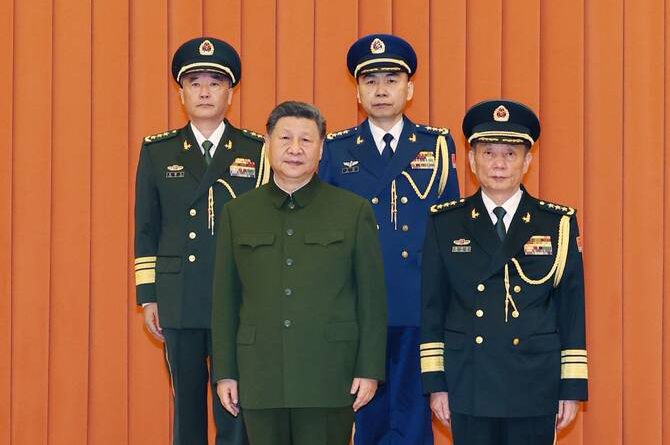
BEIJING-Chinese President Xi Jinping has promoted two senior military officers to the rank of general, a move that analysts say could pave the way for a broader reshuffle of the People’s Liberation Army’s top leadership after an extended anti-corruption campaign significantly reduced the ranks of its highest command.
The promotions, announced at a ceremony in Beijing on Friday, come as Xi continues efforts to modernize China’s armed forces while reinforcing their loyalty to the ruling Communist Party. The military overhaul coincides with Beijing’s push to strengthen its strategic position in the Indo-Pacific, including its claims over Taiwan and other disputed territories.
Xi, who also serves as chairman of the Central Military Commission (CMC), presented promotion orders to Zhang Shuguang and Air Force commander Wang Gang. Zhang was simultaneously appointed to lead the CMC’s anti-corruption investigation body, placing him at the center of the military’s ongoing disciplinary campaign.
The appointments are widely viewed as positioning both officers for greater responsibilities within the military hierarchy. Analysts say they could eventually fill vacancies on the seven-member Central Military Commission, whose membership has been substantially reduced after a series of corruption investigations removed several senior leaders.
Among the two, Zhang appears to be the stronger candidate for elevation to the commission because of his new anti-corruption portfolio, according to analysts. Wang’s prospects are considered less certain, particularly after two other senior Air Force commanders—the leaders of the PLA’s Central and Eastern Theater Commands—were promoted to general in December.
James Char, an assistant professor at the S. Rajaratnam School of International Studies in Singapore, said Wang belongs to a new generation of People’s Liberation Army Air Force leaders with substantial operational experience who have assumed increasingly important responsibilities following the latest round of military purges.
The Central Military Commission remains the highest decision-making body within China’s armed forces and is chaired by Xi. Vice Chairman Zhang Shengmin is currently its only other active member after two former vice chairmen, including the military’s most senior general, were removed or effectively sidelined during the anti-corruption campaign.
According to Char, the sweeping disciplinary investigations have dismantled the two dominant factions that previously existed within the military establishment, giving Xi greater latitude to shape the next generation of senior commanders.
Even so, analysts caution that the pace of promotions suggests Beijing is proceeding carefully rather than rushing to rebuild the military’s leadership. Only four lieutenant generals have been elevated to the rank of general during the latest phase of the restructuring.
K. Tristan Tang, a nonresident fellow at the U.S.-based National Bureau of Asian Research, said the limited number of promotions indicates that Xi continues to assess senior officers before making further appointments.
According to Tang, the Chinese leader remains in the process of observing, testing and evaluating potential candidates before carrying out a broader leadership overhaul.
The next major opportunity for restructuring is expected at the Communist Party Congress scheduled for the autumn of next year, when the current five-year term of the Central Military Commission concludes. The composition of the next commission will be closely watched as an indicator of Xi’s continuing efforts to consolidate authority over the military while advancing long-term defense modernization.