Israeli Settlers Seize Palestinian Home Under Construction in West Bank
JALUD, WEST BANK-A group of Israeli settlers has taken over a Palestinian home under construction in the occupied West Bank village of Jalud, leaving its owner fearing he has permanently lost the property and raising concerns among residents over what they describe as an escalating pattern of settler expansion.
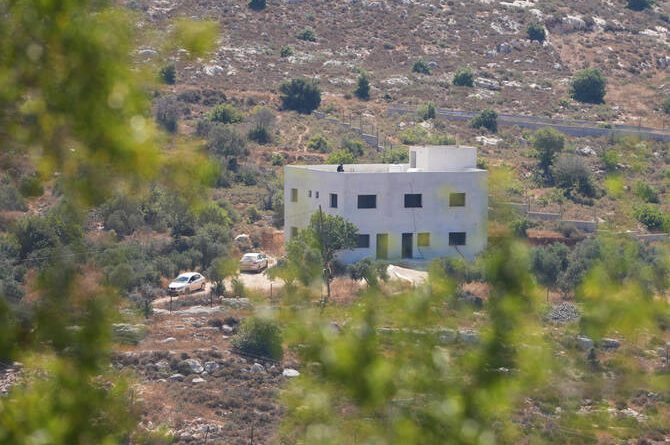
Mohammad Salameh, the owner of the unfinished two-story house, said the building had been intended as a home for his family and a future residence for his recently engaged son. Before construction could be completed, however, settlers entered and occupied the property, he said.
Video filmed earlier in the week and verified by Reuters showed at least six Israeli settlers on the roof of the house, which stands below a nearby hill. On Thursday, one settler was still visible walking on the roof, according to Reuters.
Salameh said appeals to the Israeli military and police failed to remove the settlers. He expressed concern that if the occupation of his home remains unchallenged, other Palestinian properties in the area could face similar action.
“Only God knows. If there is law and order then they will leave,” Salameh said. “If they succeeded with taking one, then the rest will follow.”
Reuters said it was unable to contact the settlers occupying the property for comment.
The Israeli military said it had received a report about the incident earlier in the week and that soldiers were dispatched to the site, where they acted to disperse a gathering. The military did not comment on the settlers’ continued presence inside the property.
The military added that law enforcement involving Israeli civilians in the West Bank falls under the jurisdiction of the Israeli police. Police did not respond to Reuters’ request for comment.
The incident highlights longstanding tensions over Israeli settlements in the occupied West Bank, where approximately 500,000 Israeli settlers live among around three million Palestinians. The expansion of settlements and violence involving settlers have remained central issues in the decades-long Israeli-Palestinian conflict.
Residents of Jalud said the latest incident marks a significant escalation because it involved the occupation of a house that had not yet been completed.
Raed Al-Hajj Mohammad, head of Jalud’s village council, said settlers had advanced to within roughly 100 meters of the village’s last row of homes and warned that another nearby house under construction could face a similar fate if authorities failed to intervene.
According to the village council, Jalud has experienced five major settler attacks in recent years, including incidents involving arson, damage to vehicles and the destruction of agricultural trees.
A United Nations inquiry published last month reported that attacks by Israeli settlers on Palestinian villages and agricultural land had increased by 130 percent since 2023. The report described a significant rise in violence linked to settlement activity across the occupied West Bank.
Most countries and the United Nations consider Israeli settlements in the West Bank to be illegal under international law, citing the Fourth Geneva Convention’s prohibition on transferring a civilian population into occupied territory. Israel disputes that interpretation, maintaining that the West Bank is disputed territory with longstanding historical and religious significance for the Jewish people.
Palestinians view the West Bank, together with East Jerusalem and the Gaza Strip, as territories that should form part of a future independent Palestinian state. Settlement expansion and settler violence have long complicated efforts to reach a negotiated peace agreement.
Although countries including the United States have criticized attacks by Israeli settlers, settlement construction has accelerated under Prime Minister Benjamin Netanyahu’s government, which depends on support from pro-settlement political parties in parliament.
For Salameh, the dispute is deeply personal. Construction of the family’s house was delayed after the outbreak of the Gaza war in 2023, when his son lost employment and the family’s financial situation deteriorated. He said he now fears that if his unfinished home cannot be recovered, neighboring Palestinian families may face similar losses.