G7 Rallies Behind Iran Truce, Presses for Lebanon Ceasefire and Tougher Russia Sanctions
Dubai-Leaders of the Group of Seven nations on Wednesday endorsed a newly announced U.S.-Iran agreement aimed at ending months of conflict, called for an immediate ceasefire in Lebanon, pledged to reduce global dependence on the Strait of Hormuz, and reaffirmed support for Ukraine while promising additional pressure on Russia.
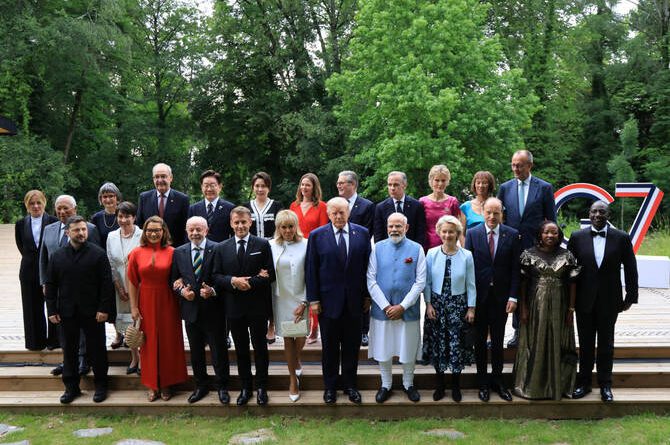
Meeting at their summit in Evian-les-Bains on the shores of Lake Geneva, the leaders issued a joint statement welcoming an interim accord reached between Washington and Tehran that is expected to launch negotiations toward a broader settlement to end the regional conflict.
“We underline the need for the negotiation to address the threats posed by Iran in the region and beyond and ensure that they never obtain a nuclear weapon,” the G7 leaders said.
The agreement, expected to be formally unveiled on Friday, extends a ceasefire first announced in April by a further 60 days to allow negotiations on a permanent settlement. The conflict has reportedly killed more than 7,000 people, with most casualties occurring in Iran and Lebanon.
The summit provided U.S. President Donald Trump an opportunity to brief fellow G7 leaders from Britain, Canada, France, Germany, Italy and Japan on the framework reached with Tehran. While the group has consistently shared concerns regarding Iran’s nuclear activities, many members had previously expressed reservations about the military confrontation that preceded the negotiations.
G7 leaders said they were prepared to support implementation of the accord. A maritime security initiative led by Britain and France is expected to assist in safeguarding shipping routes as the Strait of Hormuz is anticipated to reopen following months of disruption.
Despite the diplomatic breakthrough, significant issues remain unresolved. Iran’s government remains in power, its stockpile of enriched uranium has not yet been transferred or dismantled, and Tehran has not committed to ending support for allied armed groups across the region.
Trump said the agreement guarantees that Iran will not acquire a nuclear weapon, while U.S. officials indicated future negotiations would address the fate of Tehran’s enriched uranium reserves.
One of the most contentious issues remains Lebanon, where hostilities continue despite progress in U.S.-Iran negotiations. Israel launched military operations in Lebanon earlier this year targeting Hezbollah positions, and Israeli forces continue to hold territory in the country’s south.
The G7 statement called for an “immediate robust ceasefire” in Lebanon and urged the disarmament of Hezbollah. Iran has maintained that any lasting regional settlement must include an end to hostilities in Lebanon and an Israeli withdrawal from occupied areas.
Israel has rejected such conditions and insists it retains the right to conduct military operations against security threats. The issue has contributed to visible tensions between Washington and Israeli Prime Minister Benjamin Netanyahu’s government.
Speaking at the summit, Trump criticized Israel’s handling of the conflict, signaling a rare public divergence between the United States and its longtime ally.
A Hezbollah spokesperson told Reuters that the group believed Tehran would not support a permanent settlement if Israeli forces remained in Lebanese territory.
The proposed agreement also carries significant economic implications. According to officials familiar with the framework, it includes provisions for a $300 billion reconstruction fund for Iran, financed by neighboring Gulf states and contingent upon Iranian compliance with the accord’s terms.
A senior U.S. official said Washington would waive sanctions on Iranian oil exports under the arrangement, potentially increasing global crude supply. Energy analysts caution, however, that regional oil and gas production could require months to return to full capacity.
Reflecting concerns over disruptions to maritime trade, G7 leaders committed to accelerating efforts to diversify energy transportation routes and expand strategic reserves to reduce exposure to chokepoints such as the Strait of Hormuz.
Financial markets reacted positively to signs of de-escalation. Brent crude prices fell below $80 per barrel, reaching their lowest levels since the outbreak of the U.S.-Iran conflict, as traders anticipated the restoration of shipping traffic and energy exports.
The G7 also reaffirmed collective support for Ukraine, including its sovereignty and territorial integrity, and agreed to intensify sanctions pressure on Russia.
The unified stance underscored Kyiv’s strengthened diplomatic position following a series of successful drone operations that have complicated Moscow’s military calculus and renewed international discussion about prospects for peace negotiations.
The statement followed what Trump described as a “very good” meeting with Ukrainian President Volodymyr Zelensky and other G7 leaders on Tuesday. Zelensky indicated he could hold further discussions with the U.S. president during the summit as diplomatic efforts surrounding the war continue.