Rubio Moves to Reenergize Quad as Allies Weigh Washington’s Strategic Resolve
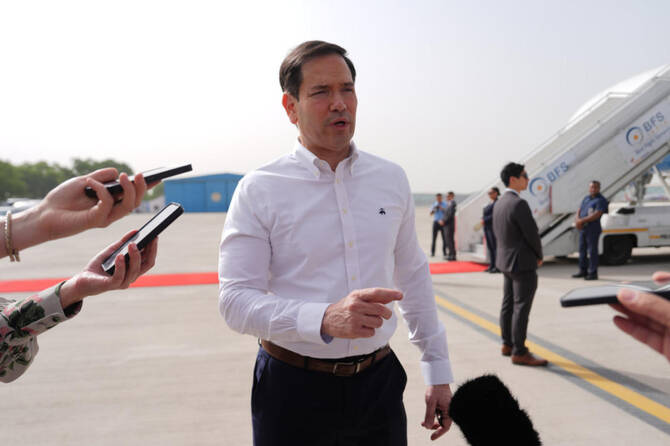
New Delhi-U.S. Secretary of State Marco Rubio met counterparts from Australia, India and Japan in New Delhi on Tuesday in an effort to reinvigorate the Quad strategic partnership, as questions persist over U.S. commitment to the grouping following disagreements over Iran and shifting diplomatic dynamics with China.
The meeting brought together India’s External Affairs Minister Subrahmanyam Jaishankar, Japanese Foreign Minister Toshimitsu Motegi, Australian Foreign Minister Penny Wong and Rubio at a time of heightened geopolitical uncertainty across the Indo-Pacific.
The talks came just days after U.S. President Donald Trump concluded a high-profile visit to China, during which he emphasized cooperation between Washington and Beijing. The visit was closely watched by regional partners concerned that closer U.S.-China engagement could diminish the strategic influence of allied nations seeking to balance China’s growing power.
The Quad, comprising the United States, India, Japan and Australia, has evolved into a key platform for cooperation on maritime security, critical technologies, supply chains and regional stability. The grouping is viewed by Beijing as an effort to counter China’s influence in the Indo-Pacific, a characterization its members reject.Rubio has sought to maintain momentum behind the alliance since taking office.
One of his first diplomatic initiatives was convening Quad foreign ministers in Washington shortly after his appointment, followed by another ministerial meeting in July 2025.Despite those efforts, uncertainty has lingered over the group’s future direction after a planned leaders’ summit in India failed to materialize last year.
The cancellation fueled concerns among some regional observers about Washington’s long-term commitment to institutionalizing the partnership.During his first official visit to India as secretary of state, Rubio said he hoped to lay the groundwork for a future summit involving Trump and the other Quad leaders. He emphasized the need for practical outcomes and concrete initiatives that leaders could announce when they eventually meet.
Among the priorities discussed was cooperation on critical minerals, an area that has gained strategic importance as governments seek to reduce dependence on Chinese-controlled supply chains for resources essential to advanced technologies, electric vehicles and defense systems.Rubio also highlighted maritime security as a central area for deeper collaboration.
Concerns about China’s expanding naval presence and territorial claims remain a shared issue for several Quad members, particularly Japan, which faces growing security challenges in nearby waters.The meeting unfolded against the backdrop of tensions in the Middle East following conflict involving Iran and disruptions affecting energy flows through the Strait of Hormuz.
Rising oil prices have created additional economic pressures for major importers such as India and Japan.Differences among U.S. partners over Washington’s policy toward Iran have complicated diplomatic coordination. While Australia expressed understanding of concerns regarding Iran’s nuclear program, neither Canberra, Tokyo nor New Delhi provided direct support for military action against Tehran.
Japan and India have historically maintained pragmatic relations with Iran and have previously balanced those ties against U.S. sanctions policies and broader strategic interests.Ahead of the Quad meeting, Motegi met Jaishankar in New Delhi and warned of a rapidly evolving global security environment shaped by shifting power balances and growing geopolitical competition.
Jaishankar, meanwhile, sought to ease concerns about U.S. engagement with the Quad, noting that Trump had supported the grouping during his first administration and remained invested in Indo-Pacific cooperation.The Quad was originally championed by late Japanese Prime Minister Shinzo Abe, who envisioned closer coordination among the four democracies in response to changing regional dynamics.
Under former U.S. President Joe Biden, the grouping broadened its agenda beyond security to include public health, infrastructure resilience, emerging technologies and supply-chain security.Tuesday’s meeting represented the latest attempt by member states to demonstrate continuity in the partnership as strategic competition in the Indo-Pacific intensifies and broader global conflicts test the cohesion of U.S.-led alliances.