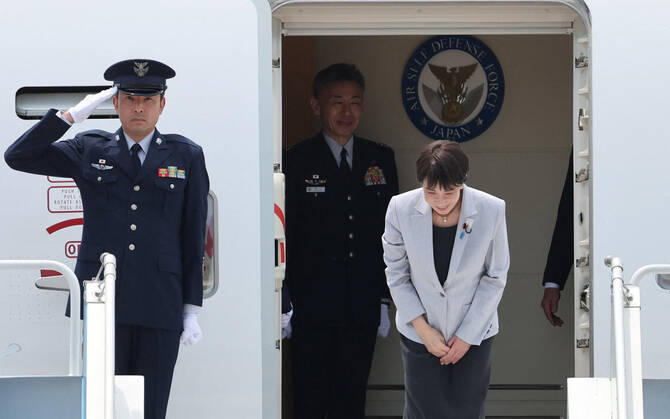
Japan, South Korea Leaders Hold Rare Hometown Summit Amid Regional Security Pressures
Seoul-South Korean President Lee Jae Myung and Japanese Prime Minister Sanae Takaichi met on Tuesday in the South Korean city of Andong for their fourth summit in six months, highlighting efforts by the two Asian neighbors to deepen cooperation despite longstanding historical tensions and mounting geopolitical uncertainty.
The meeting in Andong, a historic southeastern South Korean city known for its UNESCO-listed folk village, marked the second leg of an unprecedented series of hometown summits between the leaders. In January, Lee traveled to Takaichi’s hometown of Nara, becoming the first South Korean leader to hold a bilateral summit in a Japanese counterpart’s hometown.
South Korea’s presidential office said the latest meeting was intended to reinforce mutual trust and maintain momentum in bilateral ties, while Takaichi said before the talks that cooperation between Seoul and Tokyo was increasingly important given instability in the Indo-Pacific and the Middle East.
The summit agenda included economic and energy cooperation, the impact of the Iran conflict and broader regional security concerns, according to officials from both governments.
Analysts said the meeting reflected a strategic decision by both countries to prioritize coordination over unresolved historical disputes rooted in Japan’s 1910-1945 colonial rule of the Korean Peninsula.
“The two countries put more emphasis on agenda for cooperation than contentious issues,” said Choi Eunmi, a Japan specialist at the Seoul-based Asan Institute for Policy Studies. “They would now think constantly fluctuating or negative bilateral ties won’t be helpful to anyone.”
Relations between South Korea and Japan improved significantly in 2023 after previous administrations sought to move beyond disputes involving wartime forced labor and the issue of so-called comfort women, while strengthening coordination on regional security and supply chain resilience.
Both countries remain key United States allies confronting shared concerns over China’s regional influence and North Korea’s expanding nuclear and missile programs.
Observers initially questioned whether ties would remain stable after Lee, viewed as a political liberal, and Takaichi, known for her conservative nationalist credentials and hawkish security positions, entered office last year. However, the two leaders have maintained frequent engagement and public displays of cooperation.
In August last year, Lee selected Japan as the destination for his first bilateral summit after taking office, an unusual diplomatic move for a South Korean president. During a January meeting in Nara, the leaders participated in a public music session featuring K-pop songs, including BTS’ “Dynamite,” reflecting efforts to project warmer bilateral relations.
Analysts say broader geopolitical shifts have accelerated the rapprochement between Seoul and Tokyo, including concerns over US President Donald Trump and his administration’s trade and security policies, as well as the economic fallout from the Iran conflict.
Both South Korea and Japan have pledged major investments in the United States, while navigating uncertainty linked to tariffs, supply chain disruptions and evolving US security commitments in Asia.
Experts cautioned, however, that unresolved historical grievances could still trigger future tensions if left unaddressed.
“Both countries aren’t talking about how to resolve and prevent recurrences of conflicts over those issues,” Choi said. “We don’t know when they could occur again.”