India’s rooftop solar adoption accelerates as subsidies and peer influence drive household shift
“The pull of keeping up with neighbours helped me slash my electricity bills.”
“ The expansion of rooftop solar installations across Indian cities and villages is being shaped by a combination of government subsidies, falling entry barriers and localized social influence, according to accounts from households and officials linked to the rollout of PM Surya Ghar: Muft Bijli Yojana.
Rajat Pathak, a resident of Sigra in Varanasi, said his decision to install a rooftop solar system was influenced both by financial incentives and visible adoption within his neighborhood. Pathak first considered solar power in 2024 but was deterred by costs, estimating that a basic 1 kW system ranged between Rs 60,000 and Rs 80,000 at the time.
The launch of the central government scheme later that year renewed his interest. By 2025, multiple homes in his locality had installed rooftop systems. “The houses next door had it, and my dekha-dekhi instinct kicked in,” Pathak said, adding that a combination of subsidy benefits and neighborhood adoption influenced his decision.
He installed a 4 kW system, which he said now powers most of his household consumption during peak summer months, including air-conditioning units in rental rooms. According to Pathak, electricity costs have reduced significantly following installation.His experience reflects a broader trend.
Government data cited in the report indicates that more than 3 million households have adopted rooftop solar systems under incentive programmes, contributing to a rapid expansion in distributed renewable energy capacity.India’s solar output reached 1,08,494 gigawatt-hours in 2025, surpassing Japan to become the world’s third-largest solar power producer.
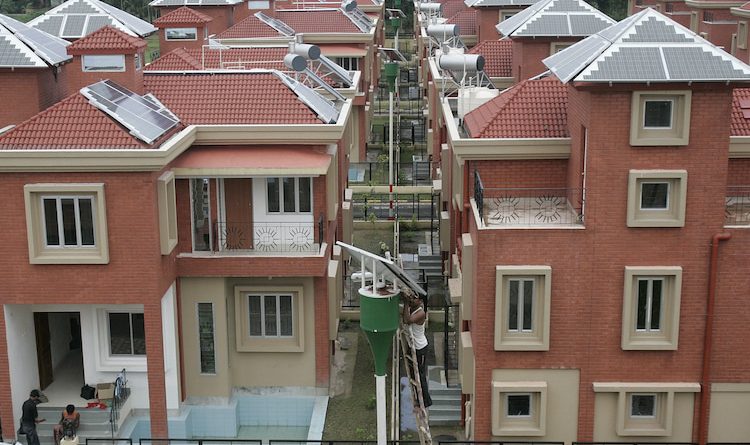
Solar energy accounted for approximately 9% of the country’s electricity generation in the 2025–26 period. Manufacturing capacity for solar modules nearly doubled from 38 gigawatts in 2024 to 74 gigawatts in 2025.In residential areas such as Greater Noida, rooftop solar adoption has also increased, with residents citing reduced electricity bills and improved system accessibility.
Around 800 homes in the area have reportedly achieved near-zero electricity bills through net metering systems, where excess power is fed back into the grid in exchange for billing credits.Residents interviewed said adoption decisions were often influenced by observation rather than formal outreach.
Santosh Malviya, a resident of Narendra Dev Nagar in Varanasi, said he installed a solar system after seeing neighboring households reduce their electricity bills. His 4 kW system has cut his monthly summer electricity expenses to between Rs 1,200 and Rs 1,500, less than half of previous levels.Under the PM Surya Ghar programme, the central government provides subsidies of up to Rs 78,000 for residential rooftop systems, depending on installed capacity.
Additional support from state agencies can add between Rs 20,000 and Rs 30,000. Subsidy payments are processed through direct benefit transfer following installation, inspection and verification.The uptake is not limited to urban clusters. In Manyachiwadi village in Maharashtra’s Satara district, residents collectively transitioned to solar energy.
According to village head Ravindra Mane, the decision was driven by persistent power outages, particularly during the monsoon season. The village, with a population of about 420, has not paid electricity bills for two years after installing rooftop systems across households. Excess energy is stored for use during periods of low solar generation.
In urban settings, early adopters reported operational and financial adjustments associated with solar use. Shiven Sharma, a resident of Gandhinagar, said his 5 kW system generates about 18 units of electricity daily. Under local tariff structures, surplus electricity fed into the grid earns a lower rate per unit than the cost of grid electricity consumed during deficits, particularly in monsoon periods.
Despite these differences, Sharma said the long-term cost benefits remain positive. Installation costs, however, remain a consideration. Sachin Kumar Attri, a software professional in Greater Noida, said his 5 kW system cost around Rs 3 lakh, offset by Rs 78,000 in central subsidy and Rs 30,000 from the Uttar Pradesh New and Renewable Energy Development Agency.
Attri said the installation process involved applying through the national portal, selecting an empanelled vendor and coordinating with the local electricity distributor, Noida Power Company Limited, for net metering. A bidirectional meter was installed within approximately 15 days of approval.
Documentation requirements included identity verification, bank details, electricity bills and ownership proof, along with agreements related to net metering. Officials said the streamlined process has improved adoption rates compared to earlier schemes.
However, some users reported initial delays due to vendor inexperience and confusion over approved panel brands. Mukul Gupta, another resident of Greater Noida, said his 8 kW system took over a year to become fully operational due to such issues. Installed at a cost of approximately Rs 5 lakh, he recovered about Rs 1 lakh through subsidies.
Gupta said his winter electricity bills are limited to fixed charges of around Rs 900 to Rs 1,000, while summer bills range between Rs 3,000 and Rs 4,000 despite running multiple air-conditioning units. He estimated monthly savings of up to Rs 10,000 during peak summer.
The concept of sanctioned load, defined by distribution companies as the maximum approved consumption capacity, remains relevant in managing electricity costs. Higher sanctioned loads allow simultaneous use of high-power appliances but increase fixed charges.The expansion of rooftop solar has also been observed in other regions.
Lucknow has emerged as a leading district in installations, surpassing Surat, while adoption has expanded into states such as Odisha, where nearly 85,000 households have enrolled under the scheme.Industry observers attribute the trend to a combination of policy support, financing access and visible adoption within communities.
The increase from roughly 100,000 rooftop solar households in 2016 to nearly 3 million by 2025 underscores the pace of expansion in distributed solar infrastructure.