He Built a Doctor, But Could Not Be Saved: The Silent Sacrifice of a Father
“I spent my life teaching my son how to save others — I never thought he would one day stand helpless before saving me.”
In a small town where dreams are often measured by survival rather than ambition, Rahim Ahmad spent his entire life carrying one belief like prayer: his son would become a doctor.Rahim was not a wealthy man.
He worked wherever work was available as a mason in summer, a porter in winter, and sometimes as a helper in orchards during harvest season. His hands were permanently rough, his back permanently bent, and his sleep permanently incomplete.
But every rupee he earned had a destination: his son Ayaan’s education.Neighbors remember Rahim as a man who rarely bought clothes for himself. He would patch old sweaters instead of replacing them. During winters, while others bought kangris and warm blankets, Rahim quietly paid another tuition installment.
School fees came before medicine, before comfort, before dignity.His wife often argued with him. “You are killing yourself,” she would say. Rahim would smile and answer, “If my son becomes a doctor, maybe he will save lives mine could never touch.”That dream began in childhood.
When Ayaan was eight, he once returned home crying because a classmate mocked his torn shoes. That evening, Rahim sold the only watch gifted to him by his late father and bought school books instead of shoes.“Shoes will tear again,” he told his son.
“Education will not.”Ayaan studied under dim bulbs during frequent power cuts. Rahim sat beside him, not because he understood biology or chemistry, but because he believed presence was also a form of support. Sometimes he would stay awake the whole night after a labor shift, just to make tea before his son’s exams.Years passed like unpaid debts.
Intermediate school became coaching classes. Coaching became medical entrance preparation. Medical entrance became rejection. Then another attempt. Another year of sacrifice. Another year of Rahim borrowing money from relatives who had stopped believing in impossible dreams.
Finally, the result came.Ayaan had cleared the medical entrance examination.That day, Rahim cried in public for the first time. Witnesses still remember him distributing sweets he could barely afford. He walked through the market not like a laborer, but like a king. People congratulated him as though the degree already belonged to him.
“Doctor sahib’s father,” they called him.
For Rahim, that title was enough.Medical college was harder. Fees were higher, expenses endless.
Hostel charges, books, instruments, exam forms each demand arrived like another mountain. Rahim sold a small piece of ancestral land that had survived generations. People said he was foolish.
He replied, “Land feeds one family. Education feeds generations.”Ayaan completed MBBS after years of struggle. Internship followed. Then a posting at a district hospital. The son had become what the father had dreamed.
On the day Ayaan wore his white coat for the first time, Rahim stood quietly outside the hospital gate. He refused to enter, saying his dusty clothes were not fit for hospitals.
But when he saw patients calling his son “doctor,” he folded his hands and looked upward.That night he said only one sentence: “Now I can die peacefully.”Life, however, rarely listens to such sentences kindly.A few years later, Rahim began feeling constant chest pain.
At first he ignored it, calling it old age and fatigue. Fathers are often experts in hiding illness. He continued working, continued pretending, continued saying, “It is nothing.”One winter morning, he collapsed while returning from the mosque.
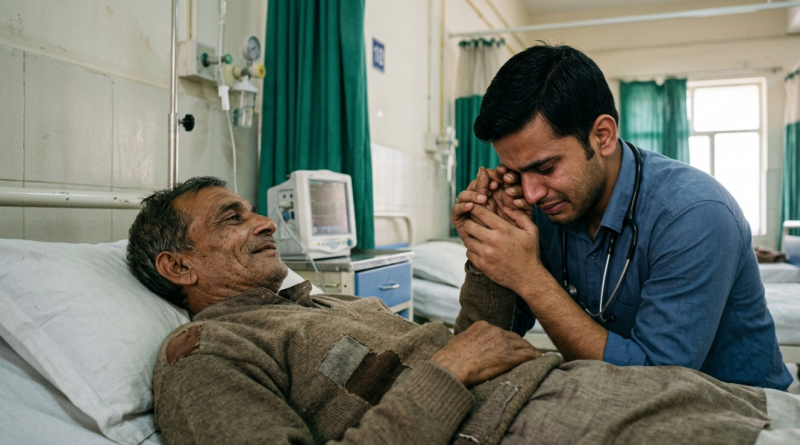
The same son he had built with blood and sacrifice rushed him to the hospital.Tests were done. Reports arrived. The diagnosis was late-stage cardiac failure complicated by multiple untreated conditions.
Years of neglect, untreated hypertension, exhaustion, and silence had turned into something medicine could not easily reverse.Ayaan, now the doctor everyone trusted, stared at his father’s reports like a stranger reading his own failure.
He knew the language of disease. He understood prognosis, intervention, survival rates. But knowledge offers no mercy when the patient is your father.Rahim looked at him and smiled weakly.“Why are you afraid?” he asked. “I made you a doctor, not God.”In hospital corridors where Ayaan had once walked with confidence, he now walked like a child lost in grief.
He signed forms with shaking hands. He called specialists. He searched for miracles hidden between medical terms.But medicine has limits, and love cannot negotiate with death.Rahim passed away on a quiet evening, with his son holding the same hands that had once held his schoolbag.
At the funeral, people did not speak first about the doctor. They spoke about the father.They remembered the man who skipped meals to pay fees. The father who sold land to buy books. The laborer who wore broken slippers so his son could wear a stethoscope.
Ayaan stood among mourners, not as Doctor Ayaan Ahmad, but simply as Rahim’s son.Later, he would say to a local reporter, “People think success is the degree hanging on my wall. They are wrong. Success was my father walking to work with fever and never telling us.
Success was him choosing my future over his present. I became a doctor because he spent his life becoming my backbone.”There are many fathers like Rahim whose names never appear in certificates, whose sacrifices remain undocumented, whose dreams are signed in sweat rather than ink.Their stories end quietly — often before they are thanked.Rahim did not leave behind wealth, land, or inheritance.
He left behind a doctor, a lesson, and a grief too large for language.Sometimes the greatest tragedy is not death itself, but realizing too late that the person who taught you how to save lives was the one you could not save.