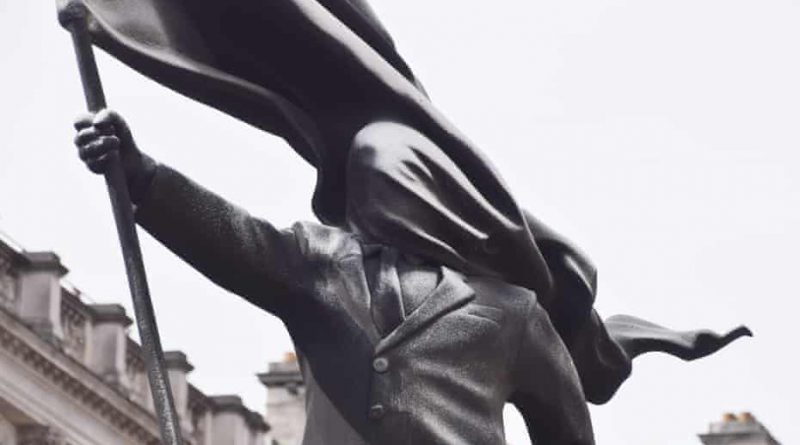
Banksy Unveils New London Sculpture of Flag-Bearing Figure in Westminster
“The sculpture depicts a man marching forward while carrying a large flag that completely obscures his face, turning anonymity itself into the central image of the work.”
London — Street artist Banksy has confirmed that a newly installed sculpture in central London, depicting a man marching forward with his face entirely covered by a large flag, is his latest work, marking another rare public intervention by the elusive artist in the British capital.
The statue appeared overnight in Waterloo Place, Westminster, an area lined with official monuments and historic memorials near St James’s and close to government buildings and ceremonial landmarks. The work was first noticed on Wednesday, with Banksy’s signature scrawled at the base of the plinth, prompting immediate speculation over its authenticity.
Banksy confirmed authorship on Thursday through a post on Instagram, where he shared a video showing the sculpture being transported through London late at night before being installed at the site. The footage included images of nearby national symbols and landmarks, including the statue of former British Prime Minister Winston Churchill, British flags, a Beefeater guard and a traditional black cab, suggesting a deliberate visual dialogue between the new work and established representations of British identity and state symbolism.
The sculpture itself shows a male figure stepping forward from a plinth while holding a large billowing flag that covers his entire face. The concealment of the subject’s identity appears central to the composition, contrasting with the traditional commemorative statues surrounding it, many of which celebrate named military, royal and political figures.In the video posted by Banksy, a passerby is asked for his opinion of the statue and replies, “No, I don’t like it,” a brief exchange that adds to the artist’s longstanding use of public reaction as part of the presentation of his work.
The statue has been placed in Waterloo Place, near monuments to Edward VII, Florence Nightingale and the Crimean War Memorial, an area known for its formal statuary and ceremonial significance. Its location places it within one of London’s most symbolically charged public spaces, where imperial memory and national commemoration dominate the landscape.
Banksy, whose identity remains officially unconfirmed, is best known internationally for politically charged graffiti works that appear without warning in public spaces and often address war, migration, inequality, surveillance and state power. While murals and stencil works remain his most recognisable form, he has previously installed sculptural works in London.One of his best-known earlier sculptures, “The Drinker,” was installed on Shaftesbury Avenue in London’s West End in 2004.
The work was a satirical reinterpretation of Auguste Rodin’s “The Thinker,” showing the figure slumped with a traffic cone placed on its head. It was removed shortly after installation. In 2019, Sotheby’s withdrew the sculpture from auction following concerns over its ownership and removal history.Banksy’s most recent confirmed London work before the Waterloo Place statue was a mural unveiled in December showing two children lying on their backs and looking upward.
The mural appeared near Centre Point Tower and was widely interpreted as referencing homelessness, with the tower long associated with Britain’s housing inequality and homelessness debates. The children in the mural appeared to be pointing toward the building, linking the artwork to wider concerns over urban displacement and housing insecurity.
Another work appeared in September outside the Royal Courts of Justice, where Banksy created a mural showing a judge using a gavel to strike a protester lying defenseless on the ground. The image emerged during a period of heightened arrests linked to demonstrations involving signs associated with the proscribed activist group Palestine Action. The mural was later removed.
Court authorities said they were legally required to preserve the listed character of the building and could not retain the artwork permanently.The new Westminster sculpture arrives as public interest in Banksy’s identity has again intensified following a recent Reuters investigation that reported the artist was likely Robin Gunningham, a Bristol-born figure who has long been suspected of being Banksy.
Reuters said its findings aligned with a similar investigation first published by the Mail on Sunday in 2008.Gunningham has denied being Banksy. According to Reuters, Banksy’s lawyer, Mark Stephens, said the artist “does not accept that many of the details contained within your inquiry are correct” and stressed that anonymity remained essential because Banksy had been “subjected to fixated, threatening and inappropriate behaviour.”The preservation of anonymity has long been central to both the artist’s legal protection and public mythology.
Banksy’s work frequently appears without official permission and often challenges institutions of power, making anonymity both a practical necessity and a core part of the artistic identity itself.The new sculpture’s use of a face hidden behind a national flag may also reinforce that theme, placing concealment, identity and public symbolism at the centre of the work.
Unlike conventional monuments that celebrate recognisable individuals, the Waterloo Place installation removes personal identity altogether, replacing portraiture with obscurity.Its proximity to Churchill’s statue is particularly notable. Churchill remains one of Britain’s most politically contested historical figures, and monuments associated with imperial history and nationalism have been the subject of repeated public debate in recent years.
By placing a faceless flag-bearer within this landscape, the work appears to invite reflection on patriotism, public memory and the politics of visibility.No official statement has been issued by Westminster authorities regarding the installation or whether it will remain permanently in place. As with many Banksy works, questions over ownership, preservation and removal are likely to follow.
Public artworks by Banksy often trigger disputes between local councils, private property owners and cultural institutions over conservation and commercial value. Several murals have been removed for protection or sale, while others have been destroyed or painted over.
For now, the Waterloo Place statue remains in place, attracting visitors and photographers in one of London’s busiest ceremonial districts. Its sudden appearance, followed by Banksy’s confirmation, has once again turned a section of the capital into an open-air site of interpretation, where the meaning of the work is shaped as much by public debate as by the sculpture itself.