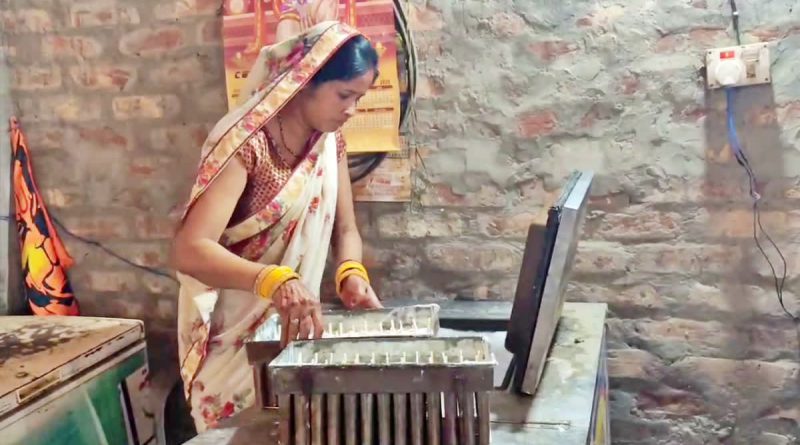
From Pandemic Hardship to ₹30 Lakh Enterprise: Bihar Woman Builds Ice-Cream Business Through Self-Help Group Support
“When opportunity meets resilience, poverty stops being a destiny and becomes only a chapter.”
What began as a struggle for survival during the economic disruption of the COVID-19 lockdown has turned into a growing rural enterprise for Geeta Devi, a resident of Bihar’s Nalanda district, whose small-scale ice-cream manufacturing unit now records an annual turnover of nearly Rs 30 lakh.
Associated with the Jeevika Self-Help Group (SHG) initiative run by the Bihar government since 2017, Geeta Devi’s journey reflects the increasing role of women-led microenterprises in rural economic transformation.
Through training, financial support, and market access provided under the SHG framework, she established her own brand, “Sagar Ice Cream,” which now supplies products across nearby districts and provides employment opportunities within her community.
Geeta Devi, who lives in Nalanda with her husband Vijay Kumar, said her family faced severe financial distress during the nationwide lockdown imposed in 2020. With limited income sources and rising household expenses, sustaining daily needs became difficult.
Her husband, who had been working outside the village, returned home during the lockdown, further increasing economic pressure on the family.At that stage, Geeta turned to the Jeevika programme, formally known as the Bihar Rural Livelihoods Promotion Society, which operates under the state government to strengthen rural livelihoods, particularly among women.
Through her self-help group, she accessed training sessions focused on entrepreneurship, food processing, and small business management.Officials associated with the programme said Geeta initially began with a modest setup and limited capital. After completing technical training related to dairy products and frozen food preparation, she identified ice-cream production as a viable business opportunity due to strong seasonal demand and limited organized supply in nearby rural markets.
Using support facilitated through the SHG network, she arranged machinery and basic infrastructure required for production. She later launched “Sagar Ice Cream,” naming the brand after her son. The unit started with small-scale local distribution, supplying retailers and vendors in surrounding villages and small towns.
According to Geeta, maintaining product quality and affordability became central to sustaining the business. She focused on producing low-cost ice cream products suited to rural purchasing capacity while ensuring regular supply during the summer season, when demand rises significantly across Bihar.Over time, the business expanded beyond village-level sales.
Local distributors began sourcing products directly from her unit, increasing output and improving cash flow. She said the enterprise currently generates an annual turnover of approximately Rs 30 lakh, a figure that has significantly improved the family’s financial stability compared to the pre-pandemic period.Her husband Vijay Kumar, now back home permanently, assists in managing operations, procurement, and local distribution.
The family is also planning further expansion of the manufacturing facility to increase production capacity and introduce new product lines.State officials linked to Jeevika said Geeta’s case demonstrates the intended outcomes of the SHG model, which combines financial inclusion with enterprise development.
Bihar’s Jeevika programme has been one of India’s largest rural women’s livelihood missions, connecting millions of women through self-help groups and federations across districts.
According to official government data, Jeevika functions under the National Rural Livelihoods Mission (NRLM), a centrally sponsored programme aimed at reducing poverty by enabling poor households to access self-employment and skilled wage opportunities.
Bihar has frequently been cited as one of the stronger-performing states in SHG mobilisation under the scheme.Women entrepreneurs operating through such platforms often begin with agriculture-linked or food-processing businesses because of relatively lower entry barriers and existing local demand.
Analysts say small-scale food enterprises, including dairy and frozen products, have shown stronger resilience in semi-urban and rural markets where informal retail networks remain dominant.
The growth of businesses like Geeta’s also reflects a broader policy focus on creating “Lakhpati Didis,” a term increasingly used by governments to describe women in rural India whose annual household income exceeds Rs 1 lakh through self-employment and SHG-linked enterprises.
Several state and central schemes have aligned around this target, particularly through access to credit, training, and local market support.In Bihar, where migration has historically shaped household incomes, locally anchored enterprises have gained additional policy attention after the pandemic exposed the vulnerability of families dependent on external wage employment.
Return migration during the lockdown pushed many households to seek sustainable income opportunities within their villages.Geeta said that beyond income, the business has changed her social standing within the community. Women from nearby villages now approach her for advice on joining self-help groups and starting small enterprises of their own.
She said many families that once viewed women’s economic participation with hesitation have become more supportive after seeing visible financial results.Jeevika officials noted that such examples help improve programme participation because success stories from within the same locality often create stronger trust than formal awareness campaigns.
They said local entrepreneurship also supports rural supply chains by generating employment for transport workers, shopkeepers, and seasonal labourers.Geeta currently employs local workers during peak production periods, particularly in summer months, when demand for frozen products rises sharply.
She said expansion plans would likely create more regular employment and help improve delivery reach in neighboring districts.Her immediate goal is to scale the factory while maintaining consistent quality standards.
She said the business remains rooted in the same principle that helped it survive its earliest days: small but steady growth backed by discipline and trust.For a household that once struggled to manage basic expenses during the lockdown, the transformation has been substantial.
What began as a survival response has evolved into a functioning rural enterprise with commercial scale, local recognition, and long-term ambitions tied to one woman’s decision to turn crisis into livelihood.