From Welfare Model to Food Insecurity: Sri Lanka’s Economic Crisis Sparks Call for a Human Rights Economy
“Economic policy cannot remain the realm of experts alone—it must be shaped by the people whose lives it defines.”
Once regarded as a model for universal welfare in South Asia, Sri Lanka is now confronting rising food insecurity, strained public services and widening social vulnerability, prompting renewed calls from economists and rights advocates for a development model centered on universal entitlements rather than austerity-led growth.
For decades, Sri Lanka was recognized for its relatively strong public investments in education, healthcare and food subsidies, which helped establish high social indicators compared with many countries at similar income levels. Universal schooling, accessible healthcare and broad-based welfare programs were often cited as pillars of the country’s post-independence development strategy.
But recent years have seen that framework come under increasing pressure.
According to the Food and Agriculture Organization’s 2025 Hunger Map and the World Food Programme’s 2024 Household Food Security Overview, around one million people in Sri Lanka are now chronically undernourished, while nearly nine million more struggle to access sufficient nutritious food. Nearly four in ten households report inadequate diets, reflecting a sharp deterioration in food security in a country that was once largely self-sufficient in food production and a major seafood exporter.
The figures come against the backdrop of Sri Lanka’s prolonged economic crisis, which intensified after the country’s sovereign debt default in 2022 and triggered inflation, currency depreciation, shortages of essential goods and sweeping fiscal restructuring.
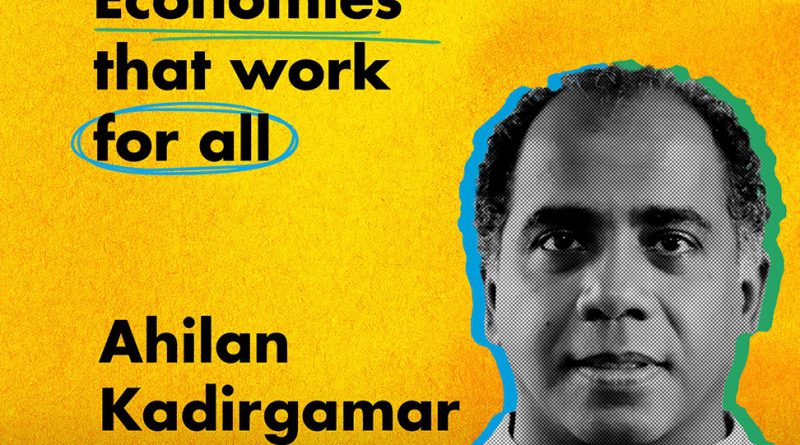
Dr. Ahilan Kadirgamar, a leading Sri Lankan economist and senior lecturer at the University of Jaffna, said the country’s current challenges reflect not only immediate economic distress but a deeper structural shift away from universal welfare protections.
He argues that austerity measures, combined with financialization and infrastructure-heavy development priorities, redirected state resources away from people-centered public services and toward projects that did not adequately protect livelihoods.
“Until recently, Sri Lanka was a country that could sustain itself and export seafood worldwide,” Kadirgamar said. “But now we are facing a situation where millions are unable to access enough nutritious food, and public institutions are under severe strain.
”According to Kadirgamar, hospitals continue to face shortages of essential medicines, universities are functioning under reduced real funding, and welfare programs have become increasingly narrow and targeted rather than universal, leaving large sections of the population exposed during periods of crisis.
He said the transition from universal subsidies toward selective welfare mechanisms has weakened the resilience of ordinary households, particularly during inflationary shocks and employment disruptions.
Kadirgamar has called for what he describes as a “Human Rights Economy,” a framework that places universal access, democratic participation and social protection at the center of economic decision-making.
Rather than treating economic planning as a technical domain reserved for specialists, he argues that citizens must have a direct role in shaping the priorities that affect their livelihoods.
“Economic policies cannot be the realm of experts,” he said. “It must be democratized. It is people’s demands that should determine economic policies.”
The concept of a Human Rights Economy has gained wider attention through advocacy by the Office of the United Nations High Commissioner for Human Rights, which frames economic governance through the lens of rights protection, equality and public accountability. The approach emphasizes that economic growth alone is insufficient if it does not translate into dignity, food security, healthcare access and social participation.
Kadirgamar said such a shift requires not only policy reform but also organized civic action.“Change will not come without action,” he said. “There needs to be coalitions organizing at every level.”He pointed to cooperatives as one practical mechanism for rebuilding resilience.
Small, democratic and community-based institutions, he said, can help reconnect producers and consumers while reducing dependence on fragile centralized supply chains and volatile global markets.In Sri Lanka, cooperative structures historically played an important role in rural development and agricultural distribution, though many weakened over time amid market liberalization and institutional decline.
Reviving such models, Kadirgamar said, could support local production while strengthening accountability and participation.“To rebuild the economy, citizens and policymakers must rethink how economic policies are made and form coalitions demanding equality, participation and universal rights,” he said.
He views the Human Rights Economy not simply as a new policy language but as a fundamental departure from the trajectory of recent decades.“That’s the context in which I understand the idea of a human rights economy,” he said. “A new framework, but one that has to completely shift from the path we have been on.”
Sri Lanka’s experience is increasingly cited in international discussions about debt, austerity and social rights, particularly as many developing economies face pressure to implement fiscal consolidation measures while managing inflation, debt servicing and weakened welfare systems.
Critics of austerity argue that reducing spending on health, education and food protection during economic recovery often deepens long-term inequality and undermines social stability, even when such measures are framed as necessary for macroeconomic reform.
Supporters of fiscal restructuring, however, argue that restoring financial credibility is essential for long-term recovery and investor confidence, especially after sovereign default.The tension between these approaches has become central to Sri Lanka’s policy debate.
The issue is also being examined through the United Nations-backed podcast series “Economies That Work for All,” produced by UN Human Rights and the UN System Staff College’s Knowledge Centre for Sustainable Development.
The series explores how human rights principles can be integrated into economic systems to support progress toward the 2030 Agenda for Sustainable Development.UN Human Rights Chief Volker Türk has also spoken publicly about the need for rights-based economic models, particularly in countries facing sovereign debt burdens and widening inequality.
For Sri Lanka, the debate is no longer theoretical. With millions facing nutritional insecurity and public institutions under visible pressure, the question of whether recovery should be measured by fiscal balance sheets or by human well-being is becoming increasingly urgent.
What emerges from that choice may shape not only the country’s economic future, but the social contract that defines it.