From Australia to Alaska: Indigenous Communities Unite to Track a Bird That Crosses Borders and Climate Frontlines
“The birds are global citizens—they do not recognise borders, only the health of the world they travel through.”
Indigenous communities separated by nearly 15,000 kilometres are joining forces to protect one of the world’s most remarkable migratory seabirds, the short-tailed shearwater, as climate change, plastic pollution and shifting ecosystems threaten its survival across two continents.
Known as yowli to the Wudjari Noongar people of Western Australia and commonly referred to as muttonbirds in other parts of Australia, short-tailed shearwaters have long been a seasonal marker for First Nations communities.
Their annual migration between Australia’s southern coastline and Alaska has connected Indigenous peoples across the Pacific for generations, with both communities using their arrival and departure to read seasonal change and environmental health.
Each year, more than 30 million short-tailed shearwaters return to breeding colonies along Australia’s southern coast, particularly concentrated in the eastern states but also in significant numbers across Western Australia’s southern islands and coastal sand dunes near Esperance, a region known traditionally as Kepa Kurl.
For the Wudjari Noongar people, the birds arrive during Djilba, the season between August and September when winter begins shifting toward spring. Historically, their sheer numbers were so vast they were said to darken the skies.
Months later, after breeding, the birds begin a journey of roughly 15,000 kilometres north to Alaska, where they feed in Arctic waters rich with fish and squid generated by melting ice and snow during the northern summer. There too, Alaska Native communities, including the Yup’ik, have long observed and marked their arrival.
But on both sides of the world, Indigenous communities have noticed troubling changes.Sick and dying birds have increasingly washed ashore, often emaciated and weakened. In some cases, their stomachs were found filled with microplastics rather than food.
Others have appeared in places far outside their traditional migration routes, suggesting they are being forced to search farther for feeding grounds as ocean conditions change.Jennell Reynolds, healthy country program coordinator and senior ranger with Esperance Tjaltjraak Native Title Aboriginal Corporation, said the decline has been impossible to ignore.“It’s so graceful seeing them skip across the water when they’re feeding and diving,” Reynolds said.
“They are such inquisitive birds when they come into the land.”Reynolds grew up hearing stories of the yowli and said the birds are deeply tied to both cultural identity and environmental monitoring.To better understand what is happening during the birds’ migration, Tjaltjraak rangers have launched a collaborative research project with Yup’ik and other Alaskan Indigenous communities, including Eyak, Iñupiaq and Alutiiq partners.
The initiative combines traditional ecological knowledge with scientific monitoring to track the birds across their full migratory route.“It was one of those things where you know that you’ve got this connection through this one bird,” Reynolds said. “We are all on the same page in relation to taking care of country.”
The partnership grew from longstanding relationships between Indigenous rangers in Western Australia and Alaska, strengthened by shared concern over declining bird populations and unusual migration patterns.David Guilfoyle, a coordinator with the Tjaltjraak rangers who spent years living and working in Alaska, said those existing ties helped quickly formalise the collaboration.
The project aims to understand not only where the birds travel, but how they behave along the way — including migration routes, feeding zones, dive depths and the environmental pressures they face during the journey.“It’s very holistic,” Guilfoyle said.
“It’s not just looking at the species so much as looking at the whole ecosystem and what role these birds play.”Until now, researchers and Indigenous communities knew where the birds departed and where they arrived, but much of what happened in between remained uncertain.To close that gap, the rangers needed to physically catch and tag the birds.
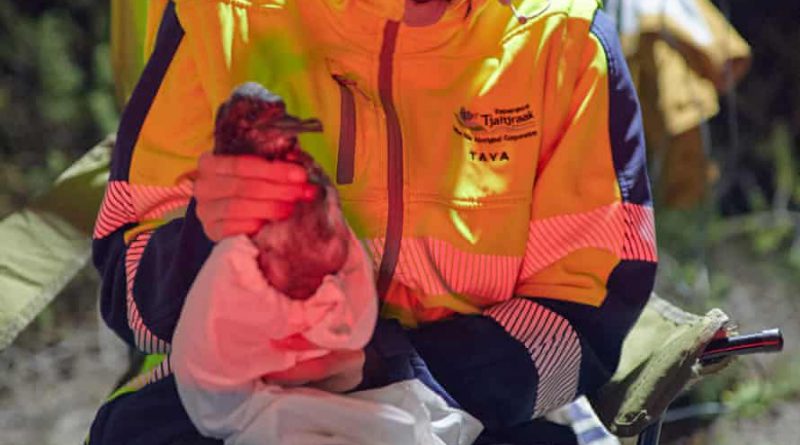
That work took place at night on isolated islands in the Southern Ocean, where rangers navigated cold, dark sand dunes using only red torchlight to avoid disturbing the birds. The environment was difficult and sometimes hazardous, with snakes and unstable terrain adding to the challenge.
Ranger Hayleigh Graham said attaching the tiny tracking devices required repeated trial and error to ensure the birds were not harmed.The team experimented with glue, tape and finally modified zip ties to safely secure the lightweight sensors to delicate legs and tail feathers.By the end of one night, they had successfully tagged 21 birds.“It’s still really early days,” Guilfoyle said.
“I can’t sleep since we’ve tagged these birds. Every hour I’m’m checking the map about where they’re going. It’s like being an expectant parent.”Early movement suggests the birds are beginning to track toward Tasmania before continuing north toward Alaska.For the rangers, the species is more than a research subject.
Guilfoyle said the birds serve as an environmental warning system because of their predictable breeding and feeding habits.“It’s like an alarm bell,” he said. “If we don’t see them as much now, what have we lost?”In Alaska, similar warnings are being observed.
Estelle Thomson, a Yup’ik leader and president of the Native Village of Paimiut Traditional Council, said shearwaters are increasingly appearing outside their usual migration range, including farther inland and southwest than previously recorded.
She linked those changes to climate disruption affecting the region’s ecosystems.Permafrost tundra is melting rapidly, exposing communities to stronger storms, coastal erosion and ecological instability. Traditional food sources, many of them migratory birds, are becoming less reliable.“We can tell when things are starting to go a little bit awry with the birds,” Thomson said.
“We can tell when they’re not getting enough food, if they’re not coming in at the times they normally do.”Thomson also works with a global Indigenous network called Children of the Sky, which connects First Nations communities across migratory bird flyways to exchange ecological knowledge.“Our peoples have specific traditional ecological knowledge about our non-human relatives,” she said.
“The people on the other side of the flyway also carry knowledge.”For Thomson, the lesson is clear.“The birds are a global citizen,” she said. “This bird has no allegiance to any specific country. It doesn’t look at the boundaries of borders.”Back in Esperance, Reynolds said the collaboration may open the door for broader partnerships between Indigenous communities facing shared ecological threats.
Before that, however, the team must return later this year to recapture the birds and remove the tags.For Reynolds, the work reflects a wider responsibility that extends beyond one coastline or one nation.
“We’re all custodians now,” she said. “It’s everyone’s responsibility to care for country.”