Palestinians Cast First Ballots Since Gaza War in Symbolic Municipal Vote
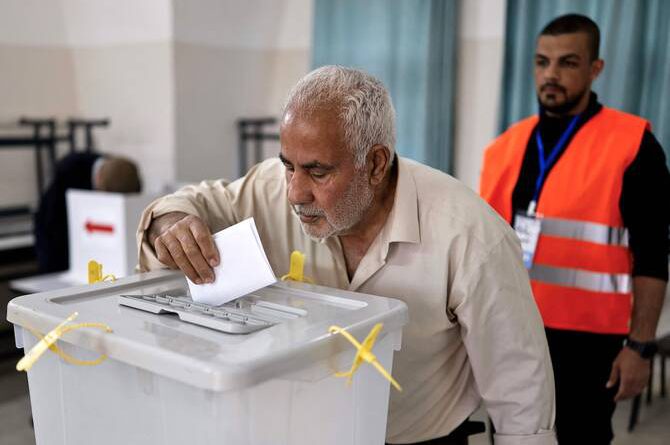
Ramallah— Palestinians in the occupied West Bank and a central area of Gaza voted on Saturday in the first elections since the Gaza war, with municipal polls unfolding amid political disillusionment, limited competition, and deep skepticism over whether the process could bring meaningful change.
Nearly 1.5 million voters were registered across the Israeli-occupied West Bank, while around 70,000 were eligible to vote in Gaza’s Deir El-Balah area, according to the Ramallah-based Central Elections Commission.
Polling stations opened at 7 a.m., with voting taking place under the shadow of continued conflict, institutional paralysis, and long-standing frustration over the absence of national elections.
Footage from Al-Bireh in the West Bank and Deir El-Balah in Gaza showed election workers preparing polling centers as residents arrived to cast ballots in what many described as a symbolic rather than transformative process.
Most electoral lists were aligned with President Mahmoud Abbas’s secular-nationalist Fatah movement or were running as independents.There were no lists affiliated with Hamas, which governs much of Gaza and remains Fatah’s principal political rival.In many municipalities, including Ramallah and Nablus, only one list was submitted, resulting in automatic victory without a contested vote.
Where competition existed, Fatah-backed candidates faced independent lists, some led by figures associated with leftist factions such as the Popular Front for the Liberation of Palestine.Mahmud Bader, a businessman from Tulkarem in the northern West Bank, said he would vote despite believing the outcome would have little practical effect.
“Whether candidates are independent or partisan, it has no effect and will have no effect or benefit for the city,” he said.“The occupation is the one that rules Tulkarem. It would only be an image shown to the international media — as if we have elections, a state or independence.
”Tulkarem has been under heightened Israeli military pressure, with two adjacent refugee camps remaining under military control for more than a year.In Gaza, the vote in Deir El-Balah marked the first local electoral exercise since Hamas won the 2006 legislative elections and later took control of the enclave in 2007.
Political analysts said the Palestinian Authority’s decision to hold voting only in Deir El-Balah reflected both logistical limits and a cautious test of public sentiment in post-war Gaza.Jamal Al-Fadi, a political scientist at Cairo’s Al-Azhar University, said the limited vote served as an “experiment” because there had been no reliable post-war opinion polling.
Deir El-Balah was selected partly because it was one of the few areas in Gaza where much of the population had remained in place and not been displaced during more than two years of war.Farah Shaath, 25, said voting for the first time was emotionally significant despite the extraordinary conditions.
“Although it is unlike any election in the world, it is a confirmation of our continued existence in the Gaza Strip despite everything,” she said.The elections commission said polling staff in Gaza were recruited from civil society groups and that a private security company had been contracted to secure voting centers.
However, a commission source in Gaza said Hamas police insisted on overseeing security around polling stations through unarmed personnel in civilian clothing.
UN coordinator Ramiz Alakbarov praised the organization of the vote, calling it a “credible process” and saying the elections represented an important opportunity for Palestinians to exercise democratic rights during an exceptionally difficult period.
Abbas, now 90, has remained in office for more than two decades without re-election, despite repeated promises of legislative and presidential polls that have yet to materialize.
Saturday’s municipal vote, while limited in scope, reflects both the persistence of Palestinian civic institutions and the deep uncertainty surrounding the future of governance in both Gaza and the West Bank.