
India’s B’nei Menashe Prepare for Mass Migration as Israel Expands ‘Homecoming’ Program
“We want to go to Israel, 90 percent for our religion, but yes, other things are better there, too.”
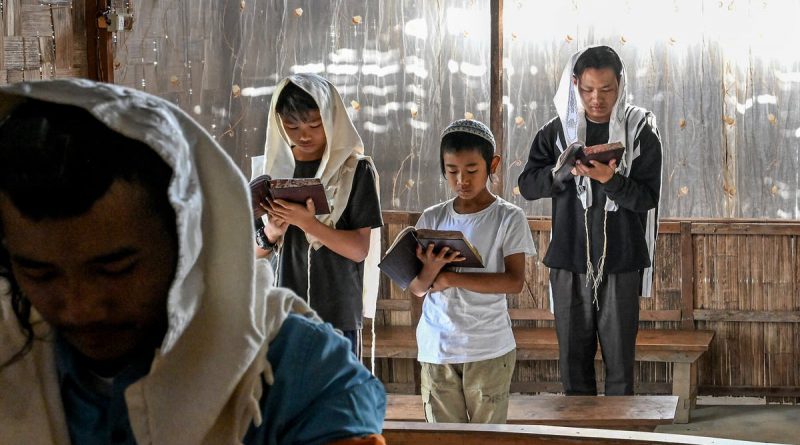
In the remote hills of India’s northeastern state of Manipur, members of the B’nei Menashe community are preparing for what they describe as a long-awaited return home — not within India, but to Israel, where they believe their ancestral roots lie.
The B’nei Menashe, a small community concentrated mainly in Manipur and neighboring Mizoram, identify themselves as descendants of Manasseh, one of the biblical Ten Lost Tribes of Israel believed to have been dispersed nearly 3,000 years ago.
While historical and anthropological evidence supporting that claim remains limited, Israel has increasingly accepted the group’s migration under a formal aliyah process, allowing them to settle as returning Jews.Around 10,000 members of the community currently live across Manipur and Mizoram, while nearly half have already relocated to Israel since the 1990s.
This week, under an operation called “Wings of Dawn,” Israel is set to fly about 250 more members from India to Tel Aviv via New Delhi, with larger numbers expected to follow in the coming years.The Israeli government approved broader support for the remaining approximately 5,800 community members in November last year, including plans for around 1,200 relocations this year.
Prime Minister Benjamin Netanyahu described the funding as “an important and Zionist decision” that would also help strengthen Israel’s northern and Galilee regions.For many in the B’nei Menashe community, the migration is framed first as a religious return rather than an economic opportunity. In villages near Churachandpur and Kangpokpi, families have preserved Jewish practices for generations while living within a largely Christian and tribal social landscape.
“We have faith in the Torah,” said Shimon Ngamthenlal, a Hebrew teacher living in a small kibbutz-style settlement in Manipur. Wearing traditional payot, the sidelocks associated with Orthodox Jewish men, he described aliyah as both spiritual fulfillment and a promise long awaited.“We have good faith in the Israeli government.
They promised that all the B’nei Menashe will go to Israel by 2030,” he said. “We all have our passports ready.”The settlements where they live remain modest, with bamboo homes, family farms and subsistence-based livelihoods. Many residents work as day laborers or in small-scale agriculture, reflecting the broader economic conditions of Manipur, one of India’s less prosperous states.
According to 2023–24 data, Manipur’s per capita economic activity was valued at roughly $1,200 annually, compared with more than $55,000 in Israel. For younger families, the contrast has added practical considerations to religious aspirations.“We want to go to Israel, 90 percent for our religion, but yes, other things are better there, too — like education,” Ngamthenlal said.
Another resident, Benjamin Haokip, said maintaining Jewish practices in the hills of northeast India remains difficult because of limited community infrastructure and the absence of broader Jewish social life.“We follow Judaism, and here we cannot follow all our customs,” he said.
Some prayers require a minyan, the quorum needed for communal worship in Judaism, while others depend on ritual familiarity and food traditions not easily sustained in isolated villages far from established Jewish communities.“The principal appeal is to worship among fellow Jews in Israel,” Haokip said.
The B’nei Menashe story has drawn attention for decades because it sits at the intersection of religion, migration and identity. In India, the group is officially classified as part of the Kuki ethnic communities, whose languages belong to the Tibeto-Burman family and whose conventional anthropological origins trace to regions that are now within China.
Most Kukis converted to Christianity during the early 20th century under the influence of American missionaries. The B’nei Menashe movement gained momentum in the 1970s after Israeli anthropologists visiting northeast India observed similarities between some pre-Christian customs and Jewish ritual traditions.
Researchers pointed to folk songs, oral histories and ceremonial practices that they believed resembled biblical narratives, including stories interpreted as recalling the Exodus from Egypt. Some local expressions used during moments of distress were also seen as resembling references to Manasseh, helping shape the identity now embraced by the community.
While scholars remain divided over the historical validity of the claim, the religious commitment of the B’nei Menashe themselves has become central to the migration process. Their identity has been shaped less by academic consensus and more by sustained faith and ritual practice over generations.
Those who have already moved to Israel often work in construction, factories and transportation. Many have settled in areas such as northern Israel, while earlier groups were placed in settlements including Hebron in the occupied West Bank and, before 2005, in Gaza settlements.Israel’s interest in expanding immigration for the group also comes amid labor shortages intensified by the wars that followed the Hamas attacks of October 7, 2023.
Military mobilization, displacement from Hezbollah rocket fire in northern regions, restrictions on Palestinian labor from the West Bank and reduced migrant labor flows from countries such as Nepal and Thailand have strained parts of the Israeli workforce.Officials see the B’nei Menashe not only as religious returnees but also as contributors to economic recovery and demographic stability in sensitive regions.
For migrants already living in Israel, the transition can be difficult. Jessica Thangjom, a member of the community now based there, works with an organization helping others relocate and adapt.She said the shift from an agrarian lifestyle in Manipur to Israel’s highly urbanized and technologically advanced environment can be challenging for new arrivals.
“Transitioning is not an easy journey,” she said, describing the cultural and economic adjustment required.Still, for many families waiting in Manipur, the move is seen less as migration than as completion of a long historical journey. In modest synagogues tucked into the hills near Myanmar’s border, prayers continue with the expectation that the next generation may soon perform them thousands of miles away.
For the B’nei Menashe, the destination is not simply another country, but what they believe to be the final chapter of a return centuries in the making.


