New York Dive Bar Faces Closure as Regulars Rally to Preserve Jimmy’s Corner
“I don’t want this place to go. It holds a lot of memories for me. For everyone.”
On a recent morning inside Jimmy’s Corner, a narrow dive bar tucked into the commercial intensity of Times Square, 73-year-old David Gladman leaned over a series of photo-covered tables, searching through decades of memories laminated beneath worn surfaces.
Using the light from his phone, he scanned images from the 1970s and 1980s before stopping at one that captured a younger version of himself sitting beside his then-wife, cigarette in hand.The photograph, he said, was just one fragment of a routine that defined much of his adult life.
Gladman, a former executive chef, recalled frequenting the bar daily between 1988 and 2012, often spending hours there after work. He described it as a place where he could decompress from the pressures of his profession before returning home.
Jimmy’s Corner, established in 1971 by former boxer Jimmy Glenn, has long operated as an anomaly within its surroundings. While Times Square has undergone decades of commercial transformation, evolving into a global hub of tourism and entertainment, the bar has retained elements of an earlier era.
Its interior is marked by aging photographs of boxers, sticker-covered restroom walls, and a narrow bar lined with worn stools. The space offers little in terms of modern amenities but has maintained a reputation for authenticity among its patrons.
That continuity is now under threat. The building housing Jimmy’s Corner is owned by the Durst Organization, which has informed current operator Adam Glenn, the founder’s son, that the bar will be evicted as the property is prepared for sale.
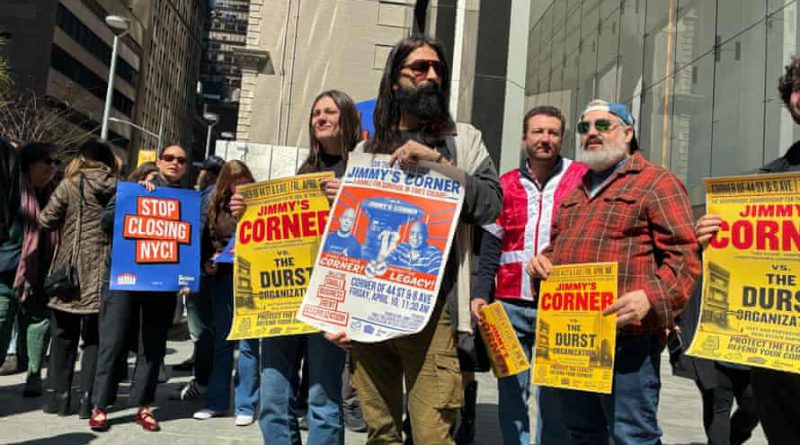
Glenn, who assumed control of the establishment in 2015, has contested the move through legal action, filing a lawsuit in an attempt to delay or prevent the eviction.The dispute has drawn attention from both patrons and local officials, prompting a public demonstration aimed at preserving the bar.
On Friday, supporters gathered outside the premises, framing the potential closure as emblematic of broader tensions between longstanding local institutions and large-scale commercial redevelopment.
Participants described the effort as a final attempt to retain a venue that, for many, represents continuity in a rapidly changing urban environment.Inside the bar, however, the mood remained outwardly upbeat. Low-cost drinks and familiar surroundings sustained a sense of normalcy even as uncertainty loomed.
Regulars continued to gather, sharing stories and reflecting on their experiences within the space. For individuals like Gladman, the bar’s significance extends beyond its physical structure.He described a longstanding relationship with Jimmy Glenn, characterizing the founder as a mentor figure who provided personal advice over the years.
Those interactions, he said, contributed to the bar’s role as more than a place of business. It functioned as a social anchor, offering stability through different phases of his life.Gladman acknowledged that the photograph he had rediscovered captured a period that has since passed.
His first marriage ended, and his former wife relocated to California. He later remarried and has been with his second wife for more than three decades. Despite these changes, his connection to Jimmy’s Corner has endured, rooted in the accumulation of shared experiences and personal history.
The potential closure has therefore been received not simply as the loss of a commercial venue but as the erosion of a communal space. Patrons interviewed at the bar emphasized its role in fostering relationships and preserving a sense of identity within a district otherwise defined by transience and commercial turnover.
The broader context reflects ongoing patterns in New York City’s real estate market, where rising property values and redevelopment pressures have contributed to the disappearance of smaller, independently operated establishments.
In high-demand areas such as Times Square, such dynamics are particularly pronounced, often favoring large-scale tenants capable of meeting increasing rental demands.Efforts to prevent the closure of Jimmy’s Corner face significant challenges.
Legal proceedings initiated by Adam Glenn remain uncertain, and the property’s sale could further complicate negotiations. Observers note that similar disputes have historically favored property owners, particularly in cases involving redevelopment of prime commercial locations.
Nevertheless, the public response underscores the cultural significance attributed to the bar. Supporters argue that establishments like Jimmy’s Corner provide continuity in an environment otherwise characterized by rapid change.
The rally, attended by patrons and local representatives, sought to highlight this dimension, though no immediate resolution has been reached.As the situation develops, regulars continue to visit the bar, aware that its future remains unresolved. For Gladman, the significance of the space is defined less by its physical attributes than by the memories it contains.
He said he does not return to revisit specific moments, such as the photograph he located, but because the environment itself evokes a sense of belonging.“I don’t want this place to go,” he said, standing near the bar where he has spent decades. “It holds a lot of memories for me. For everyone.”