Artemis II Crew Sets Record Distance in Historic Lunar Flyby
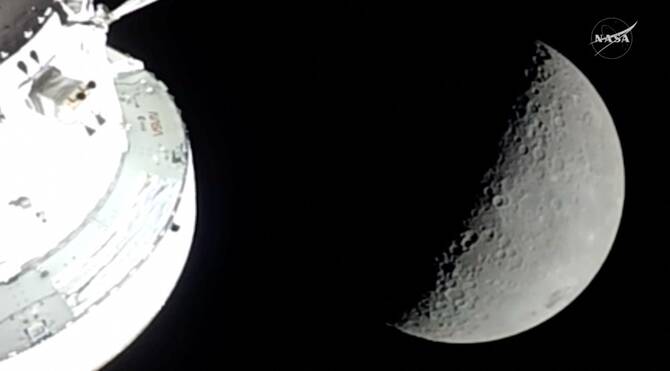
Houston— The four-member crew of Artemis II flew farther from Earth than any humans in history on Monday, reaching a distance of 252,756 miles (406,000 km) during a six-hour flyby of the Moon’s far side, as part of a mission to advance future lunar exploration.
Astronauts aboard NASA’s Orion capsule conducted direct observations of the Moon’s shadowed hemisphere, witnessing meteor “impact flashes” striking the cratered surface.
The flyby brought the spacecraft within 4,070 miles of the lunar surface roughly six days after launch.Scientists at NASA’s Johnson Space Center monitored the event in real time, recording data relayed by the crew as they passed around the Moon at a distance of about a quarter million miles from Earth.
The milestone marks the first time astronauts have traveled to the vicinity of the Moon since the Apollo program ended more than five decades ago. The previous record of roughly 248,000 miles was set in 1970 during the Apollo 13 mission, which was forced to abort its landing due to a critical malfunction.
The Artemis II crew Reid Wiseman, Victor Glover, Christina Koch, and Jeremy Hansen also photographed Earth rising and setting against the lunar horizon, a rare visual phenomenon observed only by astronauts traveling beyond the Moon’s near side.
During the flyby, communications with Earth were cut for about 40 minutes as the Moon blocked signals between the spacecraft and NASA’s Deep Space Network. The blackout period is a known feature of missions traversing the far side of the Moon.
The astronauts also identified and proposed informal names for previously unnamed lunar features, including one crater suggested as “Integrity,” after their spacecraft, and another in memory of Wiseman’s late wife.
The mission forms part of NASA’s broader Artemis program, which aims to return humans to the Moon by 2028 and establish a sustained presence, including infrastructure to support future missions to Mars.
US President Donald Trump congratulated the crew during a live communication following the flyby, calling the achievement historic and globally inspiring.