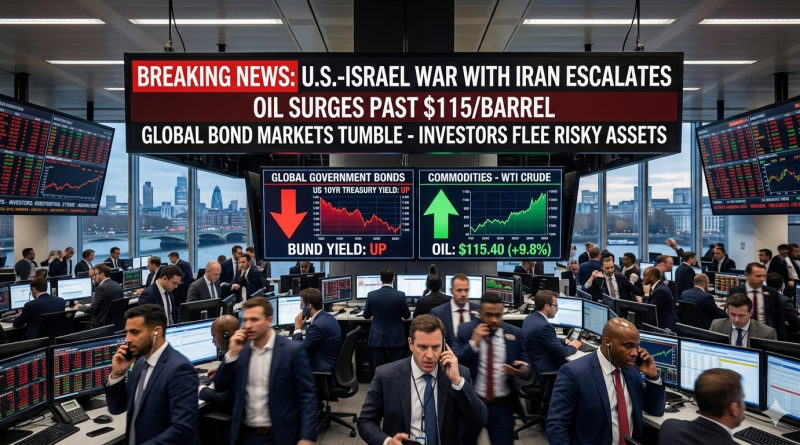
Global bond markets tumble as oil surges past $115 amid escalating U.S.-Israel war with Iran
London/Singapore, March 9- Government bond markets across Europe and Asia fell sharply on Monday as a rapidly intensifying conflict involving the United States, Israel and Iran drove oil prices above $115 a barrel, stoking investor concerns about rising inflation and the potential response from central banks.
Crude prices surged as much as 28% to nearly $120 per barrel during trading, the highest level since July 2022, as the week-long war prompted some major Middle Eastern producers to curb supplies while investors assessed the risk of prolonged disruption to shipping through the Strait of Hormuz. Benchmark Brent crude was last trading about 16% higher at roughly $107 per barrel.
The sharp move in energy markets triggered a broad sell-off in sovereign bonds, reflecting expectations that higher oil prices could fuel inflation pressures at a time when policymakers remain focused on price stability.
Investors have been closely monitoring the geopolitical fallout from the conflict in the Middle East, a region responsible for a substantial share of global crude supply. The surge in oil prices has intensified concerns that supply disruptions could become prolonged if the conflict escalates further or maritime routes remain threatened.
The rapid rise in crude prices revived worries that energy-driven inflation could complicate the outlook for monetary policy in major economies.
Higher oil costs can feed into transportation, manufacturing and consumer prices, potentially forcing central banks to reassess interest-rate paths if inflation expectations begin to climb again. Market participants said the scale and speed of the oil rally had already begun reshaping expectations across financial markets.
The latest moves underscore how quickly geopolitical tensions in key energy-producing regions can reverberate across global financial systems, affecting commodity markets, bond yields and investor risk sentiment.