OPINION: Reimagining India–Arab Relations—Beyond Oil and Diplomacy

For partners across the Arab world, engagement with India is driven less by political noise and more by tangible outcomes
India–Arab relations are often described today through the language of strategic partnerships, energy cooperation, and high-level diplomacy. Yet such framing, while accurate, understates the true depth of this engagement. Long before modern nation-states, oil economics, or global summits, the relationship between the Indian subcontinent and the Arab world was shaped by centuries of maritime trade, cultural exchange, and human movement across the Indian Ocean.
What is unfolding today is not a sudden alignment, but the modernization of a historically rooted bond—recalibrated for a rapidly changing global order. As the world transitions toward multipolarity, India’s growing global stature and the Arab world’s economic and strategic recalibration have created a convergence that goes beyond symbolism.
Within this broader India–Arab framework, Saudi Arabia occupies a particularly significant position, given its economic scale, energy influence, and ambitious transformation under Vision 2030. The partnership is increasingly driven by shared interests in energy security, technology, infrastructure, and regional stability.
A Relationship Anchored in History, Reinforced by Strategy
Trade between India and the Arab world dates back over two millennia, facilitated by monsoon winds and maritime routes linking Indian ports such as Calicut, Surat, and Cambay with Arab centers including Muscat, Aden, and Jeddah.
These exchanges were not confined to goods such as spices, textiles, and precious metals; they also carried ideas, languages, religious thought, and cultural practices. This long history of interaction fostered a familiarity that laid the groundwork for trust—an asset modern diplomacy continues to draw upon.
In contemporary times, these historical ties have evolved into some of India’s most consequential partnerships in West Asia and North Africa. The Gulf Cooperation Council (GCC) as a bloc is among India’s largest trading partners and a critical source of energy imports. Millions of Indians live and work across the Arab world, forming a vital human bridge that underpins economic and social ties.
Within this broader engagement, Saudi Arabia stands out as a pivotal anchor. It is among India’s largest trading partners in the Arab region and one of its most important energy suppliers. Bilateral trade between India and Saudi Arabia has exceeded USD 50 billion in recent years, with energy imports forming a substantial share.
At the same time, India has emerged as a reliable market and strategic partner for Saudi investments in refining, petrochemicals, infrastructure, logistics, and emerging industries.
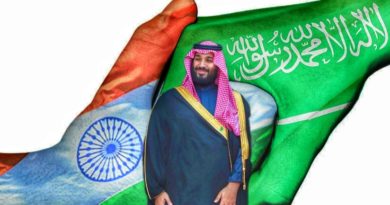
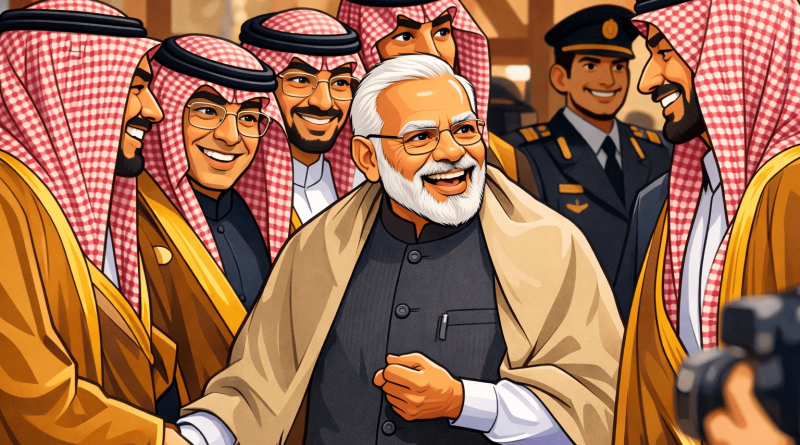
High-level political engagement—including visits by Indian Prime Ministers and Saudi Crown Prince Mohammed bin Salman—has elevated ties through institutional mechanisms such as the Strategic Partnership Council. This reflects a shift from transactional diplomacy to long-term strategic coordination, even as India deepens parallel engagements with the UAE, Qatar, Oman, Egypt, and other Arab states.
India’s Global Rise: Numbers That Tell the Story
India’s expanding relevance across the Arab world is closely linked to its broader rise on the global stage. With a population exceeding 1.4 billion, India represents one of the world’s largest consumer markets and talent pools. Its economy has crossed the USD 4 trillion mark in nominal terms, placing it among the top global economies, with projections pointing toward further ascent if current growth trajectories hold.
What distinguishes India is not only scale, but momentum. Economic growth rates around 7 percent continue to outpace most major economies, driven by domestic demand, infrastructure investment, digitalization, and a rapidly expanding services sector. For Arab policymakers and investors, this momentum has reshaped perceptions of India—from a traditional trade partner to a long-term strategic opportunity.
India’s technology ecosystem has become a key pillar of this appeal. With over 100,000 startups, millions of software professionals, and globally recognized digital public infrastructure platforms such as Aadhaar, UPI, and DigiLocker, India offers scalable models of inclusive digital governance. These capabilities align closely with the ambitions of several Arab states seeking economic diversification.
Saudi Arabia’s Vision 2030, in particular, finds strong complementarities with India’s strengths in IT services, fintech, smart infrastructure, health technology, and digital public systems. Similar alignments are visible with the UAE’s digital economy initiatives and broader Arab efforts to build knowledge-based economies.
Convergence in a Changing Global Order
India–Arab relations are also shaped by evolving geopolitical realities. As traditional power centers recalibrate and global supply chains diversify, both India and key Arab states are positioning themselves as stabilizing and adaptive actors in their respective regions. Shared concerns around energy security, food security, maritime stability, and resilient trade corridors are increasingly prominent.
Saudi Arabia’s efforts to diversify away from oil dependency intersect naturally with India’s need for reliable energy supplies, long-term investments, and access to capital. At the same time, other Arab states—such as the UAE, Qatar, and Oman—have deepened cooperation with India in ports, logistics, renewable energy, defense manufacturing, space collaboration, and food security.
Indian companies are increasingly active across Arab infrastructure and technology projects, while Arab sovereign wealth funds and private investors are expanding their footprint in Indian startups, energy ventures, and strategic assets. This convergence reflects a pragmatic understanding: in an era of uncertainty, economic resilience and strategic flexibility matter more than rigid ideological alignment.
Democracy, Debate, and the Cost of Constant Negativity
India’s rise on the global stage, including its growing engagement with the Arab world, is often accompanied by intense internal and external scrutiny. Healthy debate is essential to democracy, and constructive criticism plays a vital role in accountability and reform. However, there is a growing tendency—particularly in polarized discourse—to reduce complex national transformations into selective narratives of failure.
Ideological competition is necessary to challenge policy and refine governance. Yet when negativity becomes detached from data or context, it risks obscuring measurable progress. India’s story today is not one of perfection, but of progress at scale—something few nations in history have attempted, and fewer still have sustained.
For partners across the Arab world, engagement with India is driven less by political noise and more by tangible outcomes: growth potential, market scale, institutional continuity, and human capital. These factors increasingly define India’s credibility as a long-term partner.
A Shared Opportunity in a Defining Moment
India–Arab relations are entering a phase defined not only by historical familiarity, but by shared opportunity. As India consolidates its position as a global economic and technological force, and Arab states—particularly Saudi Arabia and the United Arab Emirates—accelerate their transition toward diversified, future-ready economies, the partnership is gaining strategic depth and global relevance.
The moment calls for confidence without complacency, ambition grounded in realism, and pride without denial. India is no longer merely responding to global shifts; it is helping shape them.
For Indians at home and across the Arab world, this evolving relationship is more than a geopolitical narrative—it is a reflection of how far India has come, and how constructively it is engaging with a region that has been connected to it for centuries.
Disclaimer: Views expressed by writers in this section are their own and do not reflect Milli Chronicle’s point-of-view.