Bangladesh is on the Brink of Chaos

But I shall never forget my people, especially at a time when the rise of extremist ideologies and violent political and religious persecution puts Bangladesh at serious risk of a period of decline from which it will take many years to recover.
Recently, the unelected Interim Government of Bangladesh, headed by Muhammad Yunus, announced that elections would be held on February 12th, 2026. The country’s largest secular political party, Awami League however, has been eliminated from the political process through violent persecution – including numerous lynchings, unjust imprisonment and torture – and arbitrary administrative measures.
This troubling chaos and political vacuum has given extremist political parties with a fanatical religious ideology – the Jamaat-e-Islami in particular – free rein to assume power, in the absence of a secular counterpart that historically stood against and prevented its rise. This alarming situation will inevitably give rise to years of instability and serious threats to regional security. It is imperative that the international community, and the United States in particular, ensure that any elections are free, fair, and all-inclusive.
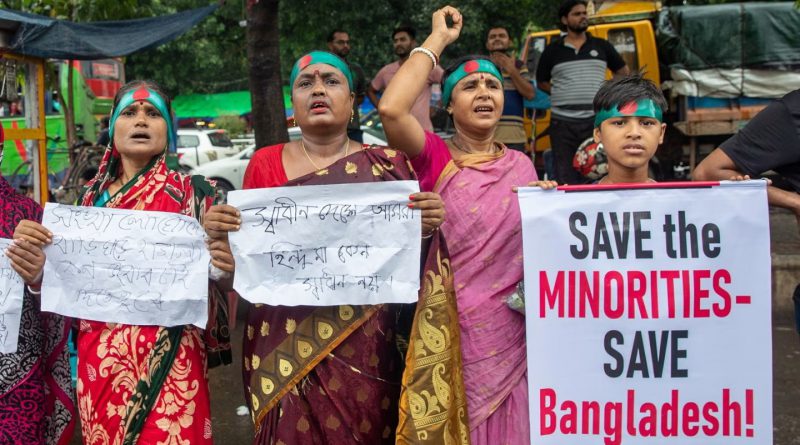
As many human rights organizations have reported, since the overthrow of the constitutional government in August 2024, there have been numerous violent attacks against Hindu, Christian, Buddhist, and other religious minorities and their places of worship. These reports document patterns of collective punishment in districts associated with secular and opposition political parties, and districts with a sizable minority population.
Several opposition political figures, including myself, have been sentenced to death in widely-condemned trials before the International Crimes Tribunal of Bangladesh, and there is a serious fear that arbitrary executions may follow.
Ironically, the Tribunal was created in 1973 to prosecute the collaborators who assisted the Pakistani army in the genocide during the 1971 War of Independence under the leadership of my father Bangabandhu Sheikh Mujibur Rahman, during which some 3 million Bangladeshi civilians were murdered and countless women and girls became victims of horrific sexual violence. These are the same political forces that are now seeking a come-back with the apparent support of the Interim Government.
When I was elected in 2008, Bangladesh was a hotbed of extremist forces and terrorism. In its tenure of 16 years, my government worked, under enormous pressure, to keep these fanatical movements contained and to protect the secular constitution of the country.
As a result, Bangladesh saw long periods of stability and unprecedented economic prosperity that witnessed an astonishing 500% increase in per capita GDP, lifting millions out of poverty. This progress was achieved against the backdrop of several plots to assassinate myself and my sole surviving family member, my sister Sheikh Rehana. All of our parents and siblings, including our 10-year old brother, were murdered in cold blood in 1975 by the same political forces that are today seeking power.
Extremist ideologies rarely vanish; they wait for opportunities created by political exclusion, institutional weakening and social fear. Today, all of the guardrails that once constrained them have started to crumble. But I have arisen from this valley of death before and will do so again, with one conviction: that it is my sacred duty to protect the democratic rights of Bangladesh and to promote the dignity of its people. I will continue to stand for this struggle no matter who tries to silence me.
Invariably, during this period of extraordinary prosperity, mistakes were also made, and there are many lessons to be learned on the historical path of progress. In particular, during 2024, amidst a campaign of hate propaganda, misinformation and violent insurrection, numerous protestors and police officers were killed.
I had immediately ordered an impartial inquiry to establish responsibility for these tragic deaths, which the Interim Government has abandoned in favour of politicized sham trials and death sentences, while at the same time offering immunity to those who instigated the violence. The purpose of the agitators was simply the unconstitutional overthrow of the Government, which resulted in my exile to India on August 5th, 2024, and the current predicament.
But I shall never forget my people, especially at a time when the rise of extremist ideologies and violent political and religious persecution puts Bangladesh at serious risk of a period of decline from which it will take many years to recover.
The exclusion of the secular Awami League from forthcoming elections is inextricably tied to the rise of extremists, who present a dire threat not only to the people of Bangladesh, but also to the United States and its allies, as a once stable, secular, and prosperous country descends into a source of perpetual instability, decline and terrorism.
Bangladesh, with a population of 170 million, is situated in a vital strategic region, at the centre of the Bay of Bengal, between India and Myanmar. If it falls in the hands of extremists and their global network, its fallout will carry consequences far beyond its borders.
Disclaimer: Views expressed by writers in this section are their own and do not reflect Milli Chronicle’s point-of-view.