Saudi astronauts achieve pioneering breakthrough in cartilage-repair nanomaterial research
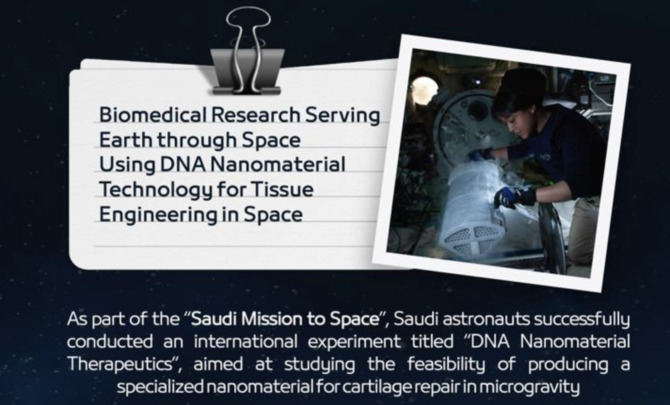
Riyadh – Saudi Arabia has reached a landmark scientific achievement with its astronauts contributing to the production of a cartilage-repair nanomaterial in space for the first time, marking a significant milestone in biomedical research.
The breakthrough builds upon the Kingdom’s SSA-HSF1 mission of 2023, reflecting Saudi Arabia’s growing leadership in space science and advanced biotechnology applications.
The Saudi Space Agency highlighted that the astronauts’ participation in 19 experiments aboard the International Space Station has the potential to enhance the quality of life on Earth through innovative medical solutions.
The research, conducted in collaboration with international scientists including Yupeng Chen and Mari Anne Snow, focused on the development of advanced biomaterials for tissue engineering and regenerative medicine.
Saudi astronaut Rayana Barnawi played a crucial role in conducting experiments and collecting data within the unique microgravity environment, enabling the production of highly reliable experimental results.
The cartilage-repair nanomaterial produced in space offers promising applications for tissue treatment, organ transplantation, and regenerative healthcare, demonstrating the strategic importance of space-based research.
The results of the experiments were published in Nature in July 2025, one of the world’s leading scientific journals, underscoring the international recognition of Saudi Arabia’s contributions to space medicine.
Barnawi emphasized that conducting experiments in space allowed for the fabrication of advanced nanomaterials that are difficult to produce under Earth’s gravity, providing critical insights for future biomedical research.
The initiative represents a collaboration between Saudi scientists and global research teams, reflecting the Kingdom’s commitment to contributing to international scientific progress and humanitarian advancement.
By leveraging the microgravity environment of the International Space Station, the project has opened new avenues for producing biomaterials with superior properties that could transform medical treatment approaches.
Saudi Arabia aims to maximize the scientific return from its human space exploration missions to benefit human health, promote innovation, and support sustainable development goals.
The research supports the Kingdom’s Vision 2030 goals by enhancing technological capabilities, fostering scientific expertise, and positioning Saudi Arabia as a global leader in space-based biomedical research.
This breakthrough also strengthens the Kingdom’s efforts to integrate space science with practical applications on Earth, creating a synergy between exploration and healthcare innovation.
The involvement of Saudi astronauts in cutting-edge research highlights the growing role of human space missions in addressing complex scientific challenges that have tangible benefits for society.
Through international collaboration, Saudi Arabia is establishing itself as a hub for advanced research in nanotechnology, tissue engineering, and regenerative medicine, attracting global scientific partnerships.
The success of these space experiments contributes to long-term goals of improving human health, developing new medical technologies, and advancing knowledge in material science and biomedical engineering.
Saudi Arabia’s approach emphasizes the combination of space exploration, scientific research, and practical healthcare applications to deliver transformative solutions for patients worldwide.
By conducting pioneering experiments in orbit, the Kingdom is creating pathways for future innovations in medical materials, demonstrating the strategic importance of space science for global human development.
The cartilage-repair nanomaterial achievement underscores the Kingdom’s commitment to scientific excellence, international collaboration, and the pursuit of knowledge that directly benefits humanity.
Saudi Arabia continues to invest in space missions, research infrastructure, and human capital to ensure that its contributions to global science are meaningful, impactful, and sustainable.