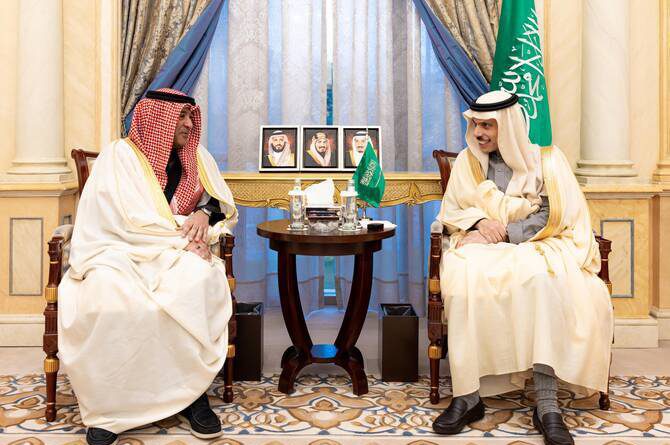
Saudi Arabia and GCC Leadership Reinforce Regional Unity in High-Level Riyadh Meeting
Riyadh – Saudi Arabia’s Minister of Foreign Affairs, Prince Faisal bin Farhan, held a constructive meeting in Riyadh with Gulf Cooperation Council Secretary-General Jassim bin Mohammed Al-Budaiwi, underscoring the Kingdom’s continued commitment to regional cooperation and collective progress.
The meeting reflected the shared vision of Gulf leaders to deepen coordination and strengthen institutional ties among GCC member states in an evolving regional and global environment.
Discussions focused on reviewing the steady progress achieved through joint GCC initiatives, highlighting the importance of unified strategies that support economic growth, political stability, and long-term regional resilience.
Both sides emphasized the value of sustained dialogue in reinforcing Gulf cohesion, noting that cooperation remains central to addressing shared challenges and advancing common interests.
Prince Faisal bin Farhan reaffirmed Saudi Arabia’s role as a strong advocate of multilateral engagement within the GCC framework, promoting collaboration across diplomatic, economic, and developmental fields.
The Secretary-General commended the Kingdom’s active leadership, stressing that coordinated Gulf action enhances the region’s collective voice on international platforms.
The meeting also explored opportunities to further harmonize policies among member states, ensuring that integration efforts continue to deliver tangible benefits to Gulf societies.
Officials highlighted the importance of institutional alignment in areas such as security cooperation, trade facilitation, energy coordination, and sustainable development initiatives.
Strengthening coordination mechanisms was seen as a key priority, enabling GCC states to respond more effectively to regional developments while safeguarding shared strategic interests.
The presence of senior officials from Saudi Arabia’s Ministry of Foreign Affairs added depth to the discussions, reflecting the Kingdom’s comprehensive approach to multilateral diplomacy.
Observers note that such high-level engagements reinforce trust and continuity within the GCC, contributing to a stable framework for long-term regional cooperation.
The meeting comes at a time when Gulf unity is increasingly viewed as a pillar for economic diversification, innovation, and regional connectivity.
By aligning visions and reinforcing common objectives, GCC leaders continue to advance a model of regional partnership rooted in dialogue, mutual respect, and shared responsibility.
The Riyadh discussions also highlighted the importance of adaptability, ensuring that GCC institutions remain responsive to global economic shifts and geopolitical changes.
Saudi Arabia’s diplomatic engagement within the GCC is widely seen as supporting broader regional ambitions, including sustainable growth and enhanced global integration.
The meeting reaffirmed a collective commitment to strengthening the GCC’s role as a platform for consultation, coordination, and consensus-building among member states.
As Gulf nations pursue ambitious national development strategies, close cooperation remains essential to maximizing shared opportunities and reinforcing regional stability.
The Riyadh engagement stands as a positive example of Gulf diplomacy in action, reflecting continuity, collaboration, and confidence in a shared future.