India’s Long Game in the Middle East: What the Jordan and Oman Visits Signal

The Jordan and Oman visits illuminate India’s current Middle East strategy: avoid binary alignments, but expand leverage through dense networks
India’s engagement with the Middle East has never been romantic. It has been driven by hard necessities: energy security, remittances from millions of Indian workers in the Gulf, and the sea lanes that keep India’s economy breathing.
What has changed under Prime Minister Narendra Modi is not the rationale, but the scale of ambition. New Delhi no longer treats West Asia as a set of disconnected files—oil here, diaspora welfare there, geopolitics somewhere else. It increasingly views the region as a single strategic theatre, where India wants to be commercially indispensable, diplomatically flexible, and strategically present—without becoming militarily entangled in conflicts it cannot control.
Modi’s mid-December 2025 visits to Jordan (15–16 December) and Oman (17–18 December) fit squarely into that doctrine. Officially, the trip was framed by India’s Ministry of External Affairs as part of a broader tour, including Ethiopia, aimed at upgrading partnerships and widening sectoral cooperation.
But in West Asia, where symbolism often carries as much weight as signatures, the choreography in Amman and Muscat mattered as much as the communiqués. The message was clear: India is courting the region with culture, commerce, and calibrated restraint—rather than ideology or force.
Jordan: Symbolism with Strategic Purpose
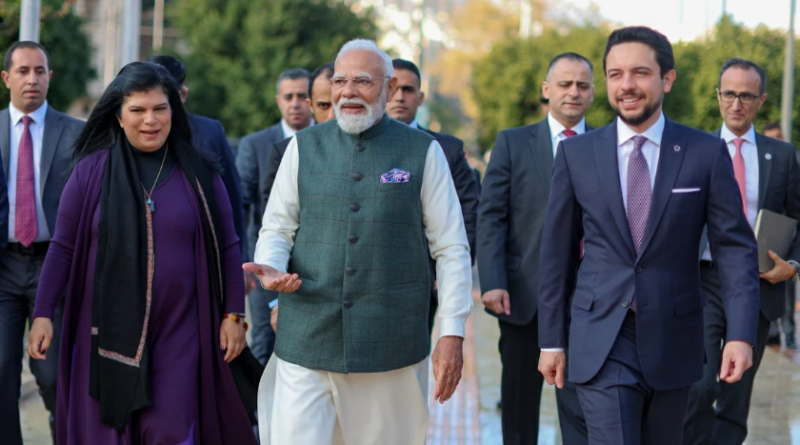
Modi’s stop in Jordan stood out less for the volume of agreements than for the optics. Reports highlighted a deliberate and unusually personal gesture: Jordan’s Crown Prince personally drove Modi to the Jordan Museum. In Middle Eastern diplomacy, such gestures are never accidental. They signal intimacy, respect, and status.
The Crown Prince, Hussein bin Abdullah II—eldest son of King Abdullah II and Queen Rania—embodies Jordan’s Hashemite identity. This is not ceremonial trivia. The Hashemite monarchy traces its lineage to the family of the Prophet Muhammad (peace be upon him), a claim widely cited by authoritative historical and official sources, and one that underpins Jordan’s custodianship over Islamic and Christian holy sites in Jerusalem. That lineage remains central to Jordan’s political legitimacy and regional soft power.
For India, acknowledging this historical-religious dimension is strategically astute. Indian diplomacy in West Asia does not operate only through state institutions; it also navigates public sentiment, religious symbolism, and historical legitimacy. Engaging Jordan on its own civilizational terms allows New Delhi to deepen ties without forcing itself into the region’s rival camps.
Symbolism, however, was paired with substance. India and Jordan announced or finalized five concrete outcomes: cooperation in renewable energy; water resources management; a twinning agreement between Petra and Ellora; renewal of the Cultural Exchange Programme for 2025–2029; and a Letter of Intent on sharing population-scale digital solutions for governance and service delivery.
Individually, these may sound technocratic. Collectively, they reflect a clear Modi-era proposition to the Middle East: India is exporting capability, not just labour or demand. Digital public infrastructure, climate adaptation know-how, and heritage diplomacy resonate strongly in states like Jordan, where water scarcity, economic pressure, and identity politics intersect.
Jordan itself is a master balancer—between larger powers, regional crises, and domestic stability. India’s approach is therefore appealing precisely because it avoids offering a security umbrella it cannot or will not enforce. Instead, it offers politically safe, materially useful cooperation, while leader-level talks still addressed shared concerns such as regional stability and counter-terrorism.
Oman: Instruments, Architecture, and the Indian Ocean Logic
If Jordan showcased narrative and nuance, Oman showcased instruments.
In Muscat, Modi received a ceremonial welcome and engaged the Indian diaspora—a familiar but still potent tool of Indian diplomacy in the Gulf. Yet the real significance lay in economic and maritime architecture. Days before the visit, India’s cabinet approved a comprehensive India–Oman trade agreement, positioning the visit as a capstone rather than a courtesy call.
Indian official statements framed the deal as opening opportunities across textiles, food processing, automobiles, gems and jewellery, and renewables—exactly the sectors both countries highlight when they speak of diversification beyond hydrocarbons.
But the visit went further. Omani media detailed a broader package: a Joint Maritime Vision Document; cooperation on millet cultivation and agri-innovation; and four MoUs spanning maritime heritage and museums, scientific research and skills development, agriculture, and institutional ties between Oman’s Chamber of Commerce and Industry and the Confederation of Indian Industry.
At first glance, the mix looks eclectic. In reality, it maps cleanly onto the geography of the Indian Ocean. Oman sits astride sea routes and chokepoints vital to India’s energy imports and trade flows. A maritime vision is therefore not poetic language; it is a strategic statement that New Delhi sees Muscat as a partner in stabilising an increasingly stressed maritime space.
By bundling maritime cooperation with food systems, research, and heritage, India signals that it views the relationship not as transactional energy diplomacy, but as long-term resilience building.
What India Is Really Building—and Where the Risks Lie
Taken together, the Jordan and Oman visits illuminate India’s current Middle East strategy: avoid binary alignments, but expand leverage through dense networks—trade agreements, digital platforms, diaspora ties, cultural legitimacy, and maritime cooperation.
It is a pragmatic approach in a region where India must simultaneously engage mutually suspicious actors while safeguarding core interests: the welfare of its citizens abroad, the stability of energy supplies, and the security of shipping lanes.
The risk is not a lack of goodwill. The risk is volatility. Trade agreements can be signed, but investment decisions freeze when wars escalate. Cultural diplomacy can soften perceptions, but public opinion can swing sharply when Gaza dominates headlines. Even a carefully “non-entangling” posture can be tested if maritime disruptions intensify and partners expect sharper choices.
Still, December 2025 sends a clear signal. India is betting on breadth over bravado. In Amman, it leaned into Hashemite symbolism while anchoring cooperation in water, climate, and digital governance. In Muscat, it pursued trade and maritime frameworks that treat Oman not merely as a hydrocarbon supplier, but as a strategic node in the Indian Ocean economy.
It is not a flashy strategy. But in a region defined by overreach and miscalculation, India’s long game is built on something rarer: patience, optionality, and relevance.
Disclaimer: Views expressed by writers in this section are their own and do not reflect Milli Chronicle’s point-of-view.