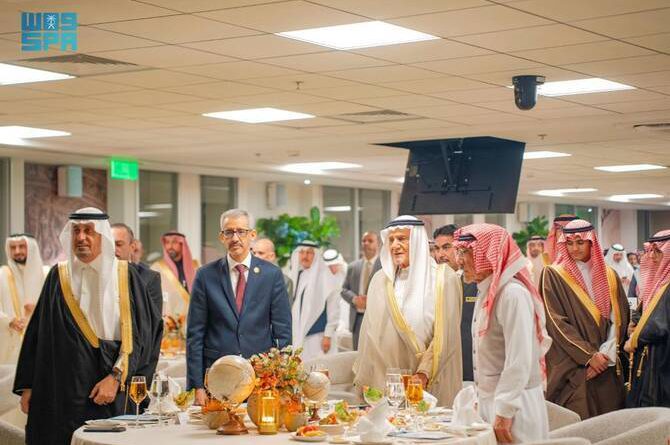
Riyadh Event Celebrates Arab Identity and Cultural Heritage
Riyadh – Arab identity and cultural heritage took center stage in Riyadh as the Arab Narrative Days event returned with its third edition, highlighting the evolution of language, history and civilizational memory.
The gathering brought together scholars, cultural leaders and researchers committed to strengthening the Arab narrative in a rapidly changing world.
The two-day event, themed “From Orientalist Narrative to Arab Narrative,” aimed to reshape how Arab culture is represented by emphasizing authentic roots and intellectual contributions.
Its purpose was to encourage renewed appreciation of Arab civilization while fostering constructive dialogue about the region’s past and present.
Prince Turki Al-Faisal inaugurated the event, recalling how the Arab aesthetic emerged from the vast silence of the desert, where clarity and imagination inspired early expressions of poetry and art.
He noted that beauty first appeared through sound and script, shaping a consciousness that later became central to Arab identity.
He emphasized the transformative moment when the Arabic language rose to prominence with the revelation, marking the beginning of a linguistic and artistic renaissance.
Arabic calligraphy, he said, became a vessel for sacred expression and helped launch a tradition of creativity that continues today.
The King Faisal Center for Research and Islamic Studies was praised for its role in documenting and preserving Arab cultural heritage.
Its collections, research programs and exhibitions were highlighted as essential tools for strengthening historical understanding and cultural awareness.
Partnership with the Arab League Educational, Cultural and Scientific Organization further enriched the event’s mission.
This collaboration supports knowledge initiatives designed to promote language, heritage and the Arab narrative on regional and international platforms.
Mohamed Ould Amar, ALECSO’s director-general, described the event as a beacon for cultural preservation and intellectual advancement.
He said that its goals align with broader efforts to protect Arab heritage and ensure its relevance in contemporary society.
He added that rebuilding the Arab narrative requires critical engagement with history and creative re-thinking of identity.’
This process links past achievements with present aspirations, shaping a modern narrative grounded in authenticity.
Arab Narrative Days builds on earlier editions that explored classical Arab storytelling, scientific contributions and the influence of the desert in shaping imagination and values.
The event continues the journey of understanding how cultural layers form identity and how they can be preserved for future generations.
The first edition in 2023 examined classical narration and the exchange of scientific knowledge between civilizations, emphasizing the importance of historical awareness.
The second edition, held in 2024, focused on the desert as a cultural archive, drawing from Bedouin traditions and early literary expressions.
This year’s edition expands these themes by addressing the evolution of the Arabic language and its centrality in shaping cultural and intellectual life.
Speakers emphasized that language remains a key pillar of identity, creativity and collective memory.
The event encourages participants to reflect on the powerful connection between language, art and history.
It highlights how understanding this relationship can strengthen cultural pride and inspire new generations to engage with their heritage.
As the discussions continue, the gathering underscores the importance of protecting and promoting Arab identity in an interconnected world.
It reaffirms that cultural preservation is not just a responsibility but a source of strength, offering a foundation for future creativity and regional unity.
The event closes with a renewed focus on building bridges between the past and the future.
Its message is clear: sustaining the Arab narrative requires active engagement, informed dialogue and a shared commitment to cultural continuity.